Electric vehicles and renewable energy storage demand batteries with higher energy density, more power, faster charging and greater safety, at a production cost the market will accept. Meeting all of these at once is what drives manufacturers and research centers to keep improving cells.
Battery performance is increasingly decided at the electrode. The materials used to produce electrodes start the process as powders and have to be handled as such. With the rise of dry processes, which remove the solvent and the drying step that follows, these powders are now processed directly during electrode manufacture.
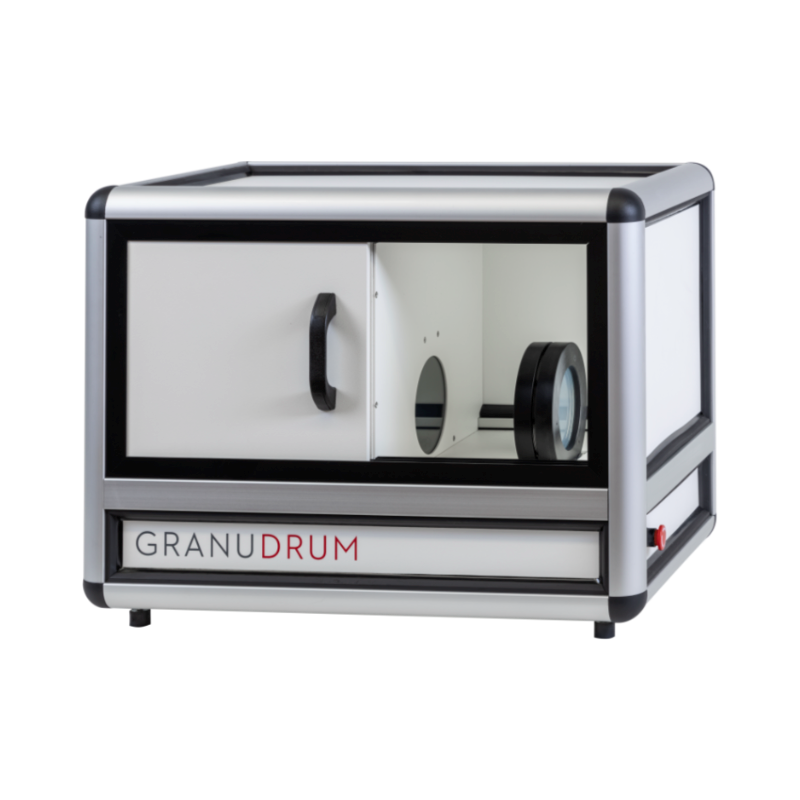
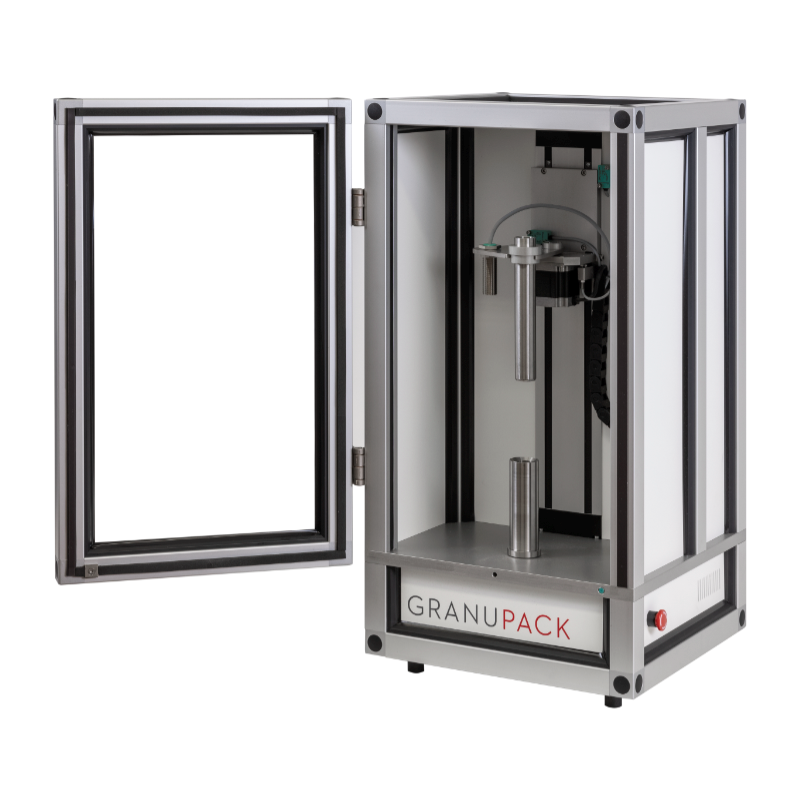
Particle engineering has become a research field in its own right, and every study in this field relies on powder characterization. The question is no longer whether powders must be characterized, but which methods describe them under real process conditions. Two of our instruments answer that question for battery powders.
Tests that reproduce the conditions of the process. A dry electrode blend is compacted, sheared and heated on the line; measuring it at rest, at ambient temperature, with a manually operated protocol, describes a material the process never sees. Two families of measurement cover most of the need: packing dynamics, which describe how a blend densifies under repeated stress, and dynamic cohesion, which describes how it flows at the shear rate it actually undergoes. In both cases, the usefulness of the result depends on how closely the test conditions match the line.
Through packing dynamics. Fibrillation turns a powder blend into a fibrous network, and that transformation leaves a measurable signature: the densities of the blend fall as the fibers develop, while the Hausner ratio stays flat. What was previously an operator’s judgment (the blend looks fibrillated enough) becomes a number that can be compared between batches, machines and sites. This matters because fibrillation has an optimum rather than a maximum: past a certain point, electrode performance degrades.
Because binders are polymer powders, and polymers do not behave the same warm as cold. Dry processes run well above ambient temperature, and two binders that look equivalent in a room-temperature test can diverge once heated, sometimes in opposite directions. A measurement made at 20 °C will rank materials in an order the line does not confirm, which is why the test has to cover the temperature range the process actually uses.
With a rotating drum. Cohesion is not a single number: a powder that flows acceptably when handled slowly can jam at line speed, and the reverse is just as common. Shear-thinning and shear-thickening behaviors only appear when the powder is measured across a range of speeds, at a free surface and without any applied load, conditions a shear cell cannot reproduce. Measured this way, cohesion becomes a predictor of processability and a basis for setting machine parameters.
Dry coating requires PTFE to be fibrillated into long fibers, giving the blend the "plastic" behavior needed to coat a current collector without solvent. Fibrillation has an optimum rather than a maximum, and both halves of that statement are measurable. On a blend of LFP (95%), carbon black (3%) and PTFE (2%), the GranuPack follows the progress of fibrillation through the densification of the blend, while conductivity measured on the same samples rises up to two minutes of fibrillation, then falls; large fibrils coated with carbon black build a conductive network, whereas the fine fibrils of over-fibrillation act as an insulator. Plotting one against the other places the conductivity maximum at an identifiable packing state, which turns an electrode-level performance target into a powder-level acceptance criterion.
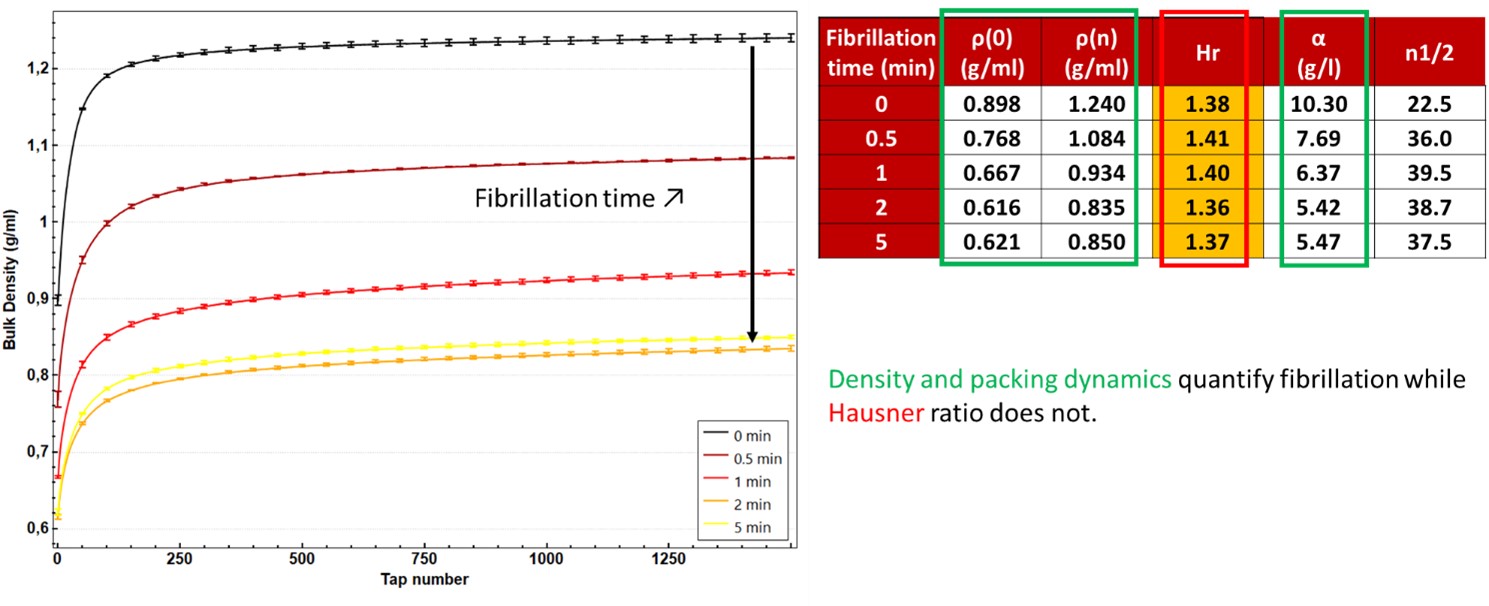
Evolution of packing dynamics and density with fibrillation time.
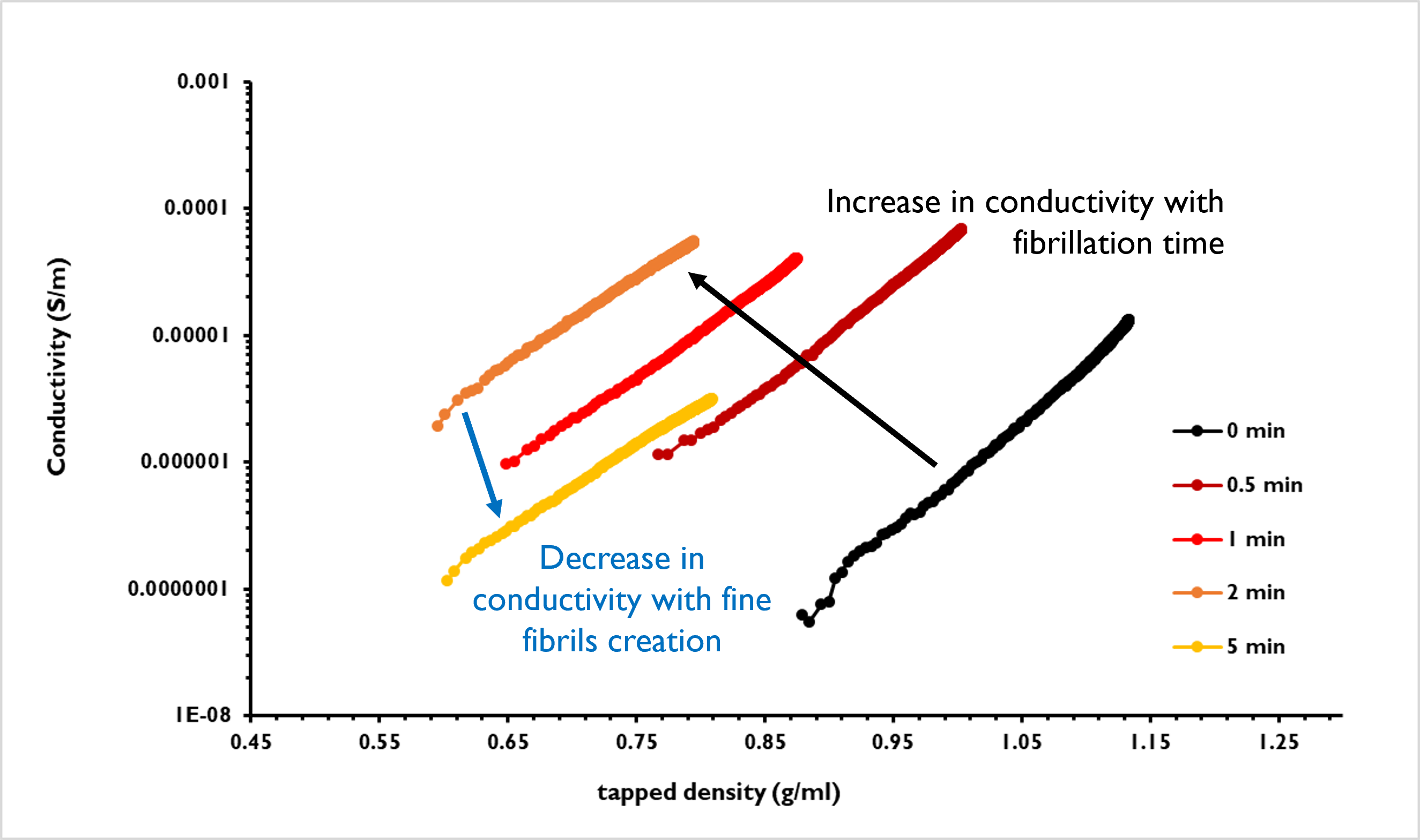
Conductivity as a function of tapped density for increasing fibrillation times (LFP 95% + CB 3% + PTFE 2%).
Dry processes handle active material, conductive additive and binder directly in powder form, and these are among the hardest powders to measure. With carbon black or graphite, a standard tapped density test is often unreadable: the surface of the bed is irregular, the reading depends on the operator, and repeated tests scatter. The GranuPack removes both sources of variability with an automated protocol and a sensor that measures the bed rather than an interface read by eye. Run up to 200 °C, the same measurement separates binders that look identical at ambient: a blend made with PVDF loses a significant part of its density around 100 °C, where the equivalent PTFE blend gains slightly.
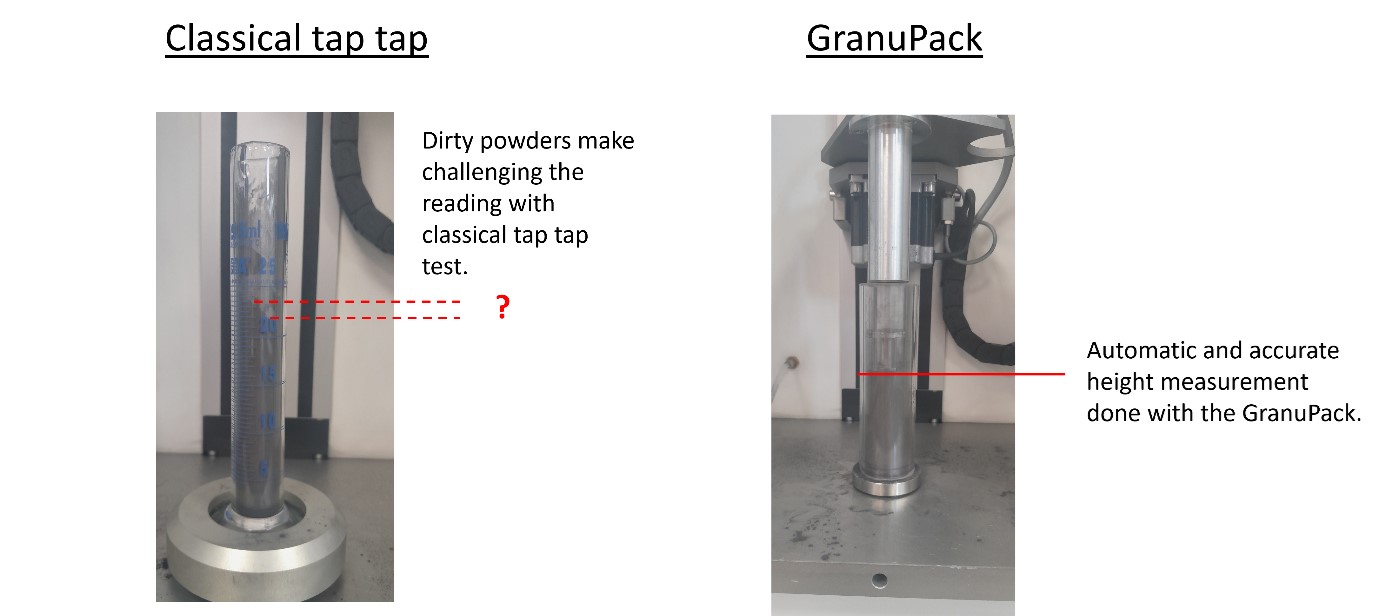
Standard tapped density method (left) vs Tapped density measurement operated by the GranuPack (right).
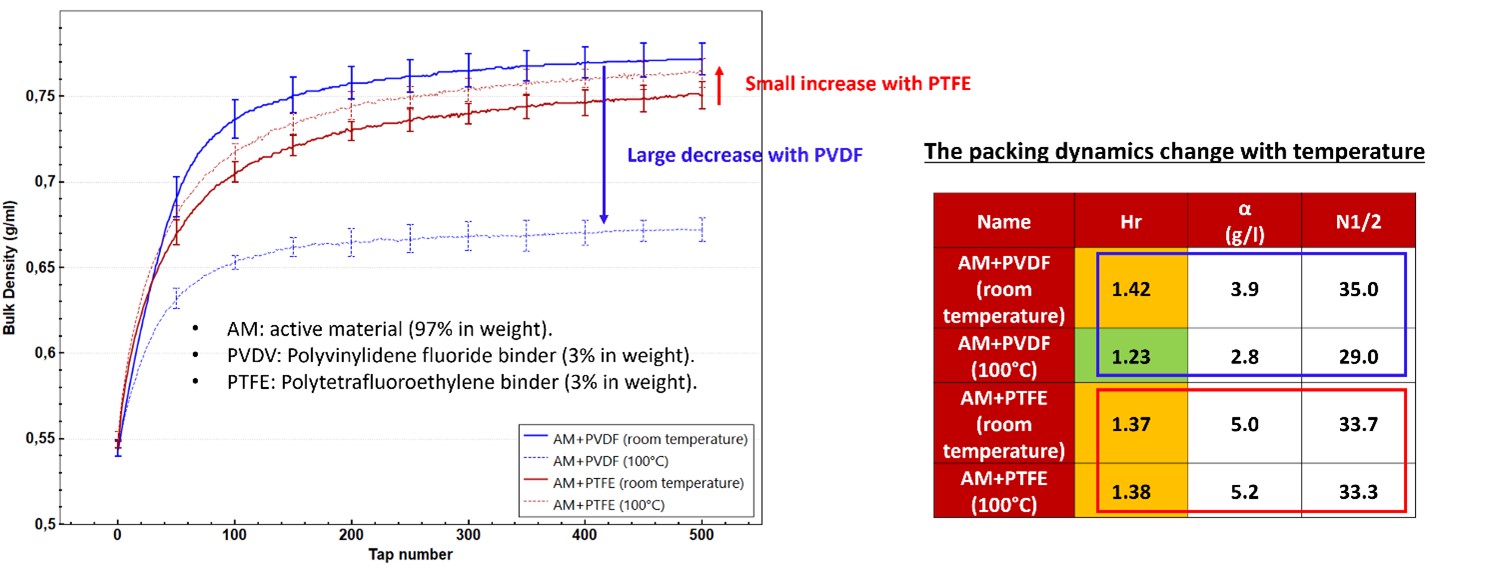
Evolution of packing dynamics and density with temperature for a battery powder blend made with PVDF or PTFE.
Sulfur-based electrodes are a promising route to higher energy density at lower cost and lower environmental impact. Building sulfur and carbon black into composite particles improves charge exchange, but it also changes how the powder behaves, and the GranuDrum shows by how much. Dry-mixed reference blends are strongly shear-thinning: their dynamic cohesive index falls from around 30 at low speed to below 10 at 60 rpm, and both S/C ratios behave almost identically. The composite powders do the opposite. One stays flat near 45 across the whole range, the other shear-thickens sharply and reaches an index above 100 at 60 rpm. At low speed the two families differ by a factor of about 1.5; at process speed, by a factor of ten or more. A single-speed flowability test would have called these formulations comparable, and the line would have proved otherwise.
For more information, check our application note "Bulk powder characterization to optimize battery manufacturing and performance".
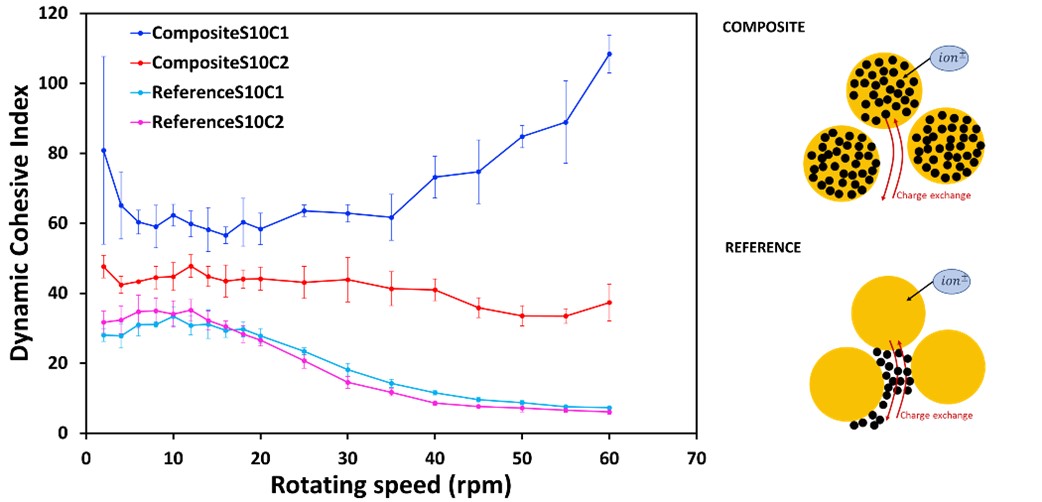
Dynamic cohesive index as a function of rotating speed for composite sulfur/carbon black powders and dry-mixed reference blends, at two S/C weight ratios. The schematic shows the difference in carbon black distribution between the two structures.