

News
Granutools Introduces the Conductivity Unit for GranuPack
Granutools introduces the Conductivity Unit for GranuPack, a new add-on extending powder characterization toward electrical conductivity measurement under controlled densification.
Introduction: Understanding Electrical Conductivity in Powders
Electrical conductivity is a fundamental property in many industrial processes, particularly in battery materials, conductive formulations, and advanced powders.
However, unlike bulk solids, powder electrical conductivity cannot be directly inferred from the intrinsic conductivity of the material. Instead, it strongly depends on:
- Particle-to-particle contacts
- Packing structure and porosity
- Surface chemistry and oxidation
- Formulation parameters (e.g., binder or conductive additives)
As a result, conductivity evolves dynamically as the powder becomes more compact. When particles rearrange during densification, the number and quality of electrical pathways increase, directly impacting conductivity.
This makes direct measurement of electrical conductivity in powder form essential to obtain meaningful, process-relevant data.
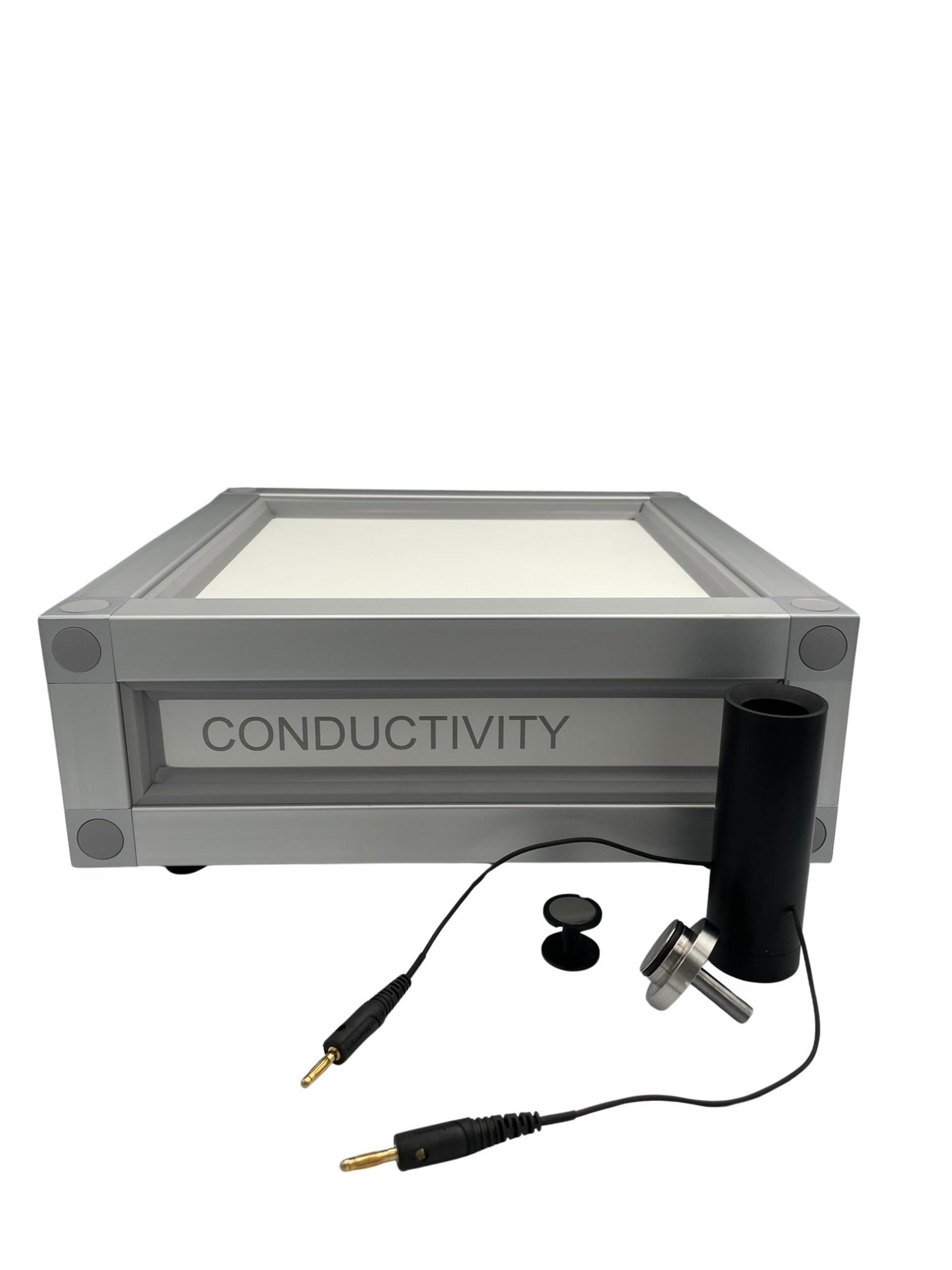
Exploring the Conductivity Unit for GranuPack: A New Measurement Approach
The Conductivity Unit for GranuPack introduces a novel methodology to couple conductivity measurement with tapped density analysis.
Integrated directly into the GranuPack system, the unit replaces the standard measurement cell with a dedicated conductivity cell. During a standard tapped density protocol:
- The powder is subjected to controlled tapping
- Its packing fraction progressively increases
- Bulk density is continuously measured
- Electrical conductivity is measured simultaneously
This approach provides a direct and reproducible way to monitor conductivity as a function of densification, enabling a deeper understanding of powder behavior under conditions close to industrial processes.
Key Measurement Principle: Conductivity vs Packing Fraction
The uniqueness of the Conductivity Unit lies in its ability to measure conductivity across different packing states.
In powders:
- At low packing fractions → limited particle contacts → low conductivity
- At higher packing fractions → increased contacts → improved conductive paths
This relationship is particularly critical because conductivity does not vary linearly with densification and is difficult to model or predict.
At the same time, the tapped density measurement reflects how particles rearrange under mechanical tapping, reducing voids and increasing solid fraction.
By combining both measurements, the device provides:
- A conductivity vs packing curve
- Insight into percolation thresholds and contact efficiency
- A quantitative basis for comparing materials and formulations
Key Features of the Conductivity Unit
Simultaneous Measurement of Conductivity and Density
The system records electrical conductivity and tapped density in a single experiment, enabling direct correlation between structure and electrical response.
Measurement Under Controlled Densification
Conductivity is measured during progressive compaction, reproducing realistic process conditions.
High Reproducibility and Automation
Fully controlled by the GranuPack software, the method ensures operator-independent results with high repeatability.
Seamless Integration
The Conductivity Unit is designed as a plug-and-play add-on compatible with existing GranuPack systems.
Applications: From Battery Materials to Advanced Powders
The Conductivity Unit is particularly relevant for battery and electrode manufacturing, where powder properties directly influence performance:
- Electrical conductivity governs electron transport in electrodes
- Densification processes (e.g., calendering) modify conductivity
- Powder formulation determines final electrochemical performance
Measuring conductivity as a function of packing provides valuable insight for:
- Material screening
- Optimization of conductive additives
- Blend comparison and formulation development
Beyond batteries, the unit supports applications in:
- Conductive polymer composites
- Additive manufacturing powders
- Metallurgy and advanced ceramics
- Any process where electrical properties of powders matter
Towards Better Process Understanding
By linking electrical conductivity to powder packing behavior, the Conductivity Unit enables a more comprehensive understanding of powder performance.
It allows users to answer key questions such as:
- How does densification impact conductivity?
- Which formulation provides the best conductive network?
- At which packing level does a conductive pathway form?
- How sensitive is conductivity to batch variations?
This information is critical to anticipate process behavior and optimize material selection before manufacturing steps.
Conclusion: Extending Powder Characterization to Electrical Properties
The Conductivity Unit for GranuPack represents a significant step forward in powder characterization.
By combining electrical and mechanical measurements in a single automated test, it provides a unique and process-relevant perspective on powder behavior.
This new approach enables:
- More informed material selection
- Improved formulation strategies
- Better control of industrial processes
The Conductivity Unit continues Granutools’ mission to deliver physically meaningful, reproducible, and application-oriented powder measurements.
FAQ – Powder Electrical Conductivity Measurement
What is powder electrical conductivity?
Powder electrical conductivity is the ability of a powder to conduct electricity, which depends on particle contacts, packing structure, and surface properties.
Why measure conductivity during densification?
As a powder becomes denser, the number of contacts between particles increases, creating conductive pathways and modifying the electrical behavior.
What does the Conductivity Unit for GranuPack measure?
The Conductivity Unit measures both electrical conductivity and tapped density simultaneously during a single automated measurement.
How does packing affect powder conductivity?
Higher packing fractions increase particle contacts, improving electrical pathways and generally increasing conductivity, although the relationship depends on material formulation.
What are the main applications of this measurement?
This method is particularly useful for battery materials, electrode formulation, and conductive powders where electrical performance is critical.