
Solution guides
How to Evaluate Fibrillation with GranuPack?
This article presents a simple method for quantifying powder fibrillation using the GranuPack.
Introduction
Fibrillation is a key step in dry electrode manufacturing for battery applications. During this process, a polymer binder such as Polytetrafluoroethylene (PTFE) is mixed with active materials and conductive additives and subjected to mechanical stresses that transform PTFE agglomerates into long fibrils.
These fibrils create a network that connects particles together and contributes to the formation of a cohesive electrode film after calendering. The degree of fibrillation strongly influences both powder processability and final electrode performance.
Because insufficient fibrillation may lead to poor mechanical integrity while excessive fibrillation can reduce process efficiency, accurately evaluating the level of fibrillation is essential.
Why Measure Fibrillation?
As PTFE fibrillation progresses:
- PTFE agglomerates are transformed into elongated fibrils.
- Particle entanglement increases.
- Particle mobility decreases.
- Powder densification becomes more difficult.
These changes directly affect the way the powder reorganizes under tapping. Since the GranuPack quantifies powder densification dynamics with high precision, it provides an effective method to monitor changes induced by fibrillation and compare different processing conditions.
Preparing Fibrillated Samples
The first step is to prepare powder batches under controlled fibrillation conditions.
Several processing parameters can influence fibrillation:
- Fibrillation time
- Processing temperature
- Shear rate
- Mixing intensity
- Equipment configuration
To investigate a specific parameter, only one variable should be modified while keeping all others constant. Each prepared batch is then characterized using the same GranuPack measurement procedure.
Measuring Powder Packing Dynamics
For each fibrillated batch, a standard GranuPack test is performed using:
- 500 taps
- 1 Hz tapping frequency
- 1 mm free-fall distance
The GranuPack records the evolution of tapped density during densification. Because fibrillation influences particle mobility, the densification kinetics become sensitive to the degree of fibrillation achieved during processing.
Understanding the Packing Dynamic Parameter α
The key metric used in this protocol is the packing dynamic parameter α, introduced by Lumay et al. (2020). This parameter quantifies how rapidly a powder densifies under tapping. When particle mobility is high:
- Rearrangement is easy.
- Densification is rapid.
- α is relatively high.
When fibrillation increases:
- PTFE fibrils create a highly entangled structure.
- Particle motion becomes restricted.
- Densification slows down.
- α decreases.
As a result, α can be used as a direct indicator of the degree of fibrillation.
Monitoring the Effect of Fibrillation Time
Figure 1 illustrates typical densification curves obtained for a powder blend containing active material, carbon black, and PTFE. As fibrillation time increases:
- The powder reorganizes more slowly.
- Tapped density evolves more gradually.
- Densification kinetics are reduced.
These differences can be detected accurately by the GranuPack and provide quantitative information about fibrillation development.
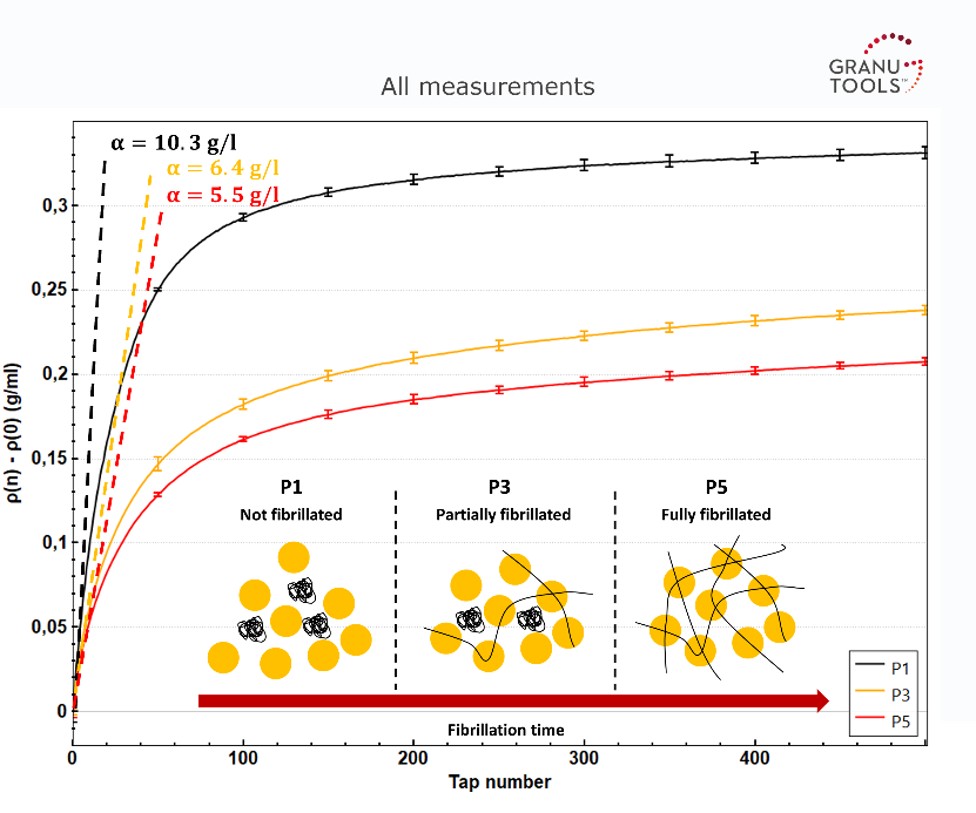
Figure 1: Tapped density as a function of the number of taps fro P1, P3 and P5.
Quantifying Fibrillation with α
Figure 2 shows the evolution of α as a function of fibrillation time. The decrease in α reflects the progressive formation of a fibrillar network within the powder blend.
A lower α value indicates:
- Stronger PTFE entanglement.
- Lower particle mobility.
- Higher fibrillation level.
As fibrillation continues, α progressively decreases until reaching a plateau corresponding to a fully fibrillated material.
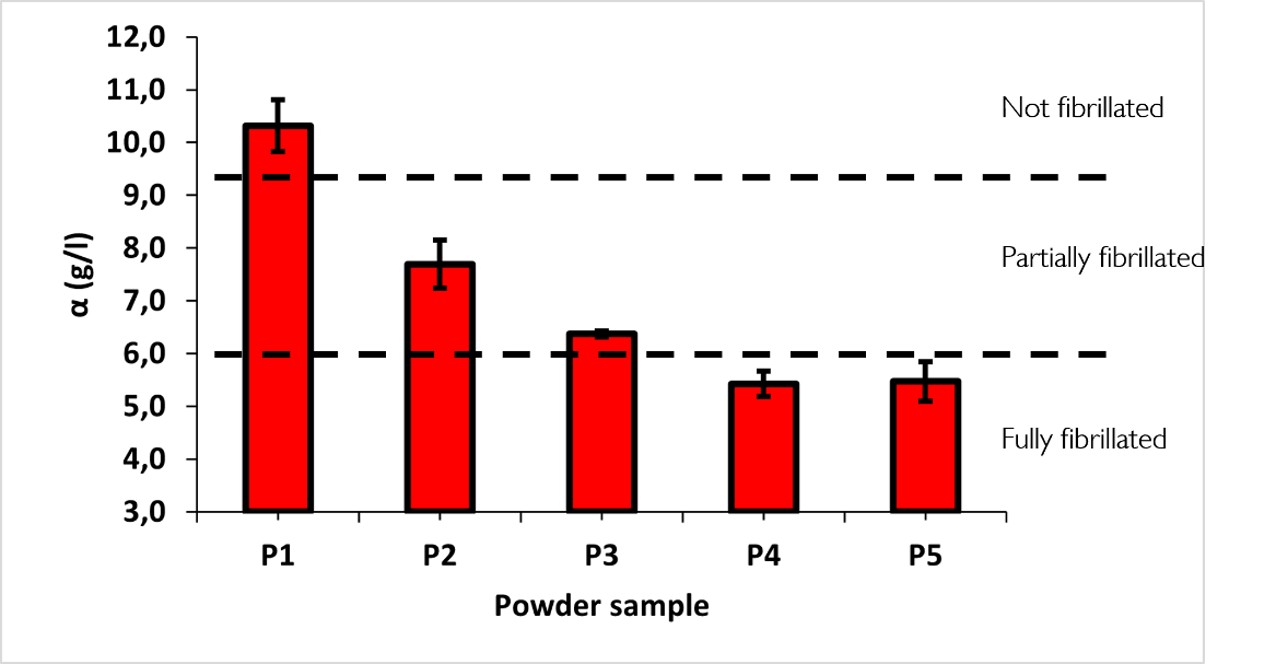
Figure 2: Decrease in α with the time of fibrillation.
Determining the Optimal Fibrillation Level
One of the practical advantages of this method is the ability to identify the point at which additional fibrillation provides little further benefit. When α reaches a plateau:
- The fibrillation process approaches completion.
- Additional mixing time may no longer significantly improve fibrillation.
- Further processing may lead to unnecessary energy consumption and reduced productivity.
Conversely, if α remains high, the material may still be insufficiently fibrillated. The parameter α therefore provides a simple and quantitative way to identify optimal fibrillation conditions.
Industrial Applications
This method is particularly relevant for:
- Dry battery electrode manufacturing
- PTFE-containing formulations
- Energy storage materials
- Conductive powder blends
- Polymer-bonded particle systems
It can also be used to optimize mixing parameters and accelerate process development.
Conclusion
The GranuPack provides a sensitive and quantitative approach for evaluating fibrillation in PTFE-containing powder blends.
As fibrillation progresses, particle mobility decreases due to the development of an entangled fibrillar network. This reduction in mobility directly affects the packing dynamic parameter α, which decreases as fibrillation increases.
By monitoring the evolution of α, users can compare fibrillation conditions, identify optimal processing parameters, and avoid both under-fibrillation and unnecessary over-processing.
For a more comprehensive evaluation of fibrillation, the GranuPack results can be complemented by Dynamic Cohesive Index measurements performed with the GranuDrum. While GranuPack quantifies the reduction in particle mobility through the parameter α, GranuDrum assesses the impact of fibrillation on powder flowability and cohesion. This complementary approach is detailed in the article “How to Evaluate Fibrillation with the GranuDrum?”.
FAQ – Evaluating Fibrillation with GranuPack
What does the parameter α represent in fibrillation studies?
The parameter α quantifies the speed of powder densification during tapping. Lower α values indicate slower rearrangement and reduced particle mobility.
Why does α decrease when fibrillation increases?
PTFE fibrils create an entangled network that restricts particle movement, slowing densification and reducing the value of α.
Can fibrillation time be optimized using GranuPack?
Yes. Monitoring the evolution of α helps identify when fibrillation reaches a plateau, indicating that additional processing may no longer be beneficial.
Which processing parameters can influence fibrillation?
Fibrillation time, temperature, shear rate, mixing intensity, and equipment configuration can all affect the development of PTFE fibrils.