
Solution guides
How to evaluate fibrillation with the GranuDrum?
Fibrillation plays a central role in the manufacturing of dry electrodes for battery applications.
In these processes, a polymer binder such as Polytetrafluoroethylene (PTFE) is blended with active materials and conductive additives before being subjected to mechanical stresses that transform PTFE agglomerates into long fibrils.
These fibrils create an interconnected network that binds the powder particles together and contributes to the formation of a cohesive film after calendering. The extent of fibrillation directly influences both powder processability and electrode quality. Insufficient fibrillation may result in poor mechanical integrity, while excessive fibrillation can alter powder handling characteristics.
Consequently, evaluating and comparing the level of fibrillation is an important step during process development and optimization. This article presents a practical method for assessing powder fibrillation using the GranuDrum.
Why Measure Fibrillation?
The performance of a dry electrode formulation depends strongly on the structure of the fibrillated binder network. As fibrillation progresses:
- PTFE agglomerates are transformed into elongated fibrils.
- Interactions between particles increase.
- Particle mobility decreases.
- The powder blend becomes more cohesive.
Because these changes affect powder flow behavior, dynamic flow measurements provide a valuable indirect method for monitoring fibrillation.
The GranuDrum enables users to compare different processing conditions and quantify their impact on fibrillation through changes in the Dynamic Cohesive Index (DCI).
Preparing Fibrillated Samples
The fibrillation process is performed before the GranuDrum measurement using a dedicated mixer or processing equipment. Several parameters can influence fibrillation, including:
- Fibrillation time
- Temperature
- Shear rate
- Mixing intensity
- Binder concentration
To investigate the influence of a given parameter, multiple powder batches can be prepared while varying only one processing condition at a time.
Each batch is then characterized using the same GranuDrum measurement protocol, allowing direct comparison of their flow behavior.
Characterizing Fibrillation with the GranuDrum
For each powder batch, a GranuDrum measurement is performed using a standard increasing-speed sequence from 2 to 60 rpm.
The resulting Dynamic Cohesive Index is evaluated over the complete rotational-speed range.
Because fibrillation progressively creates a network of entangled PTFE fibrils, particle mobility decreases and the cohesive behavior of the powder changes. These changes are reflected by variations in the Dynamic Cohesive Index.
By comparing the DCI curves obtained for different processing conditions, the influence of fibrillation parameters can be assessed quantitatively.
Understanding the Dynamic Cohesive Index
Figure 1 presents a typical example obtained for a blend containing active material, carbon black, and PTFE.
A reference powder (P1) is measured before fibrillation, while additional samples are measured after increasing levels of fibrillation.
As fibrillation progresses, the Dynamic Cohesive Index increases because the growing network of PTFE fibrils restricts particle motion and increases interactions within the powder bed.
This effect is particularly visible at intermediate rotational speeds.
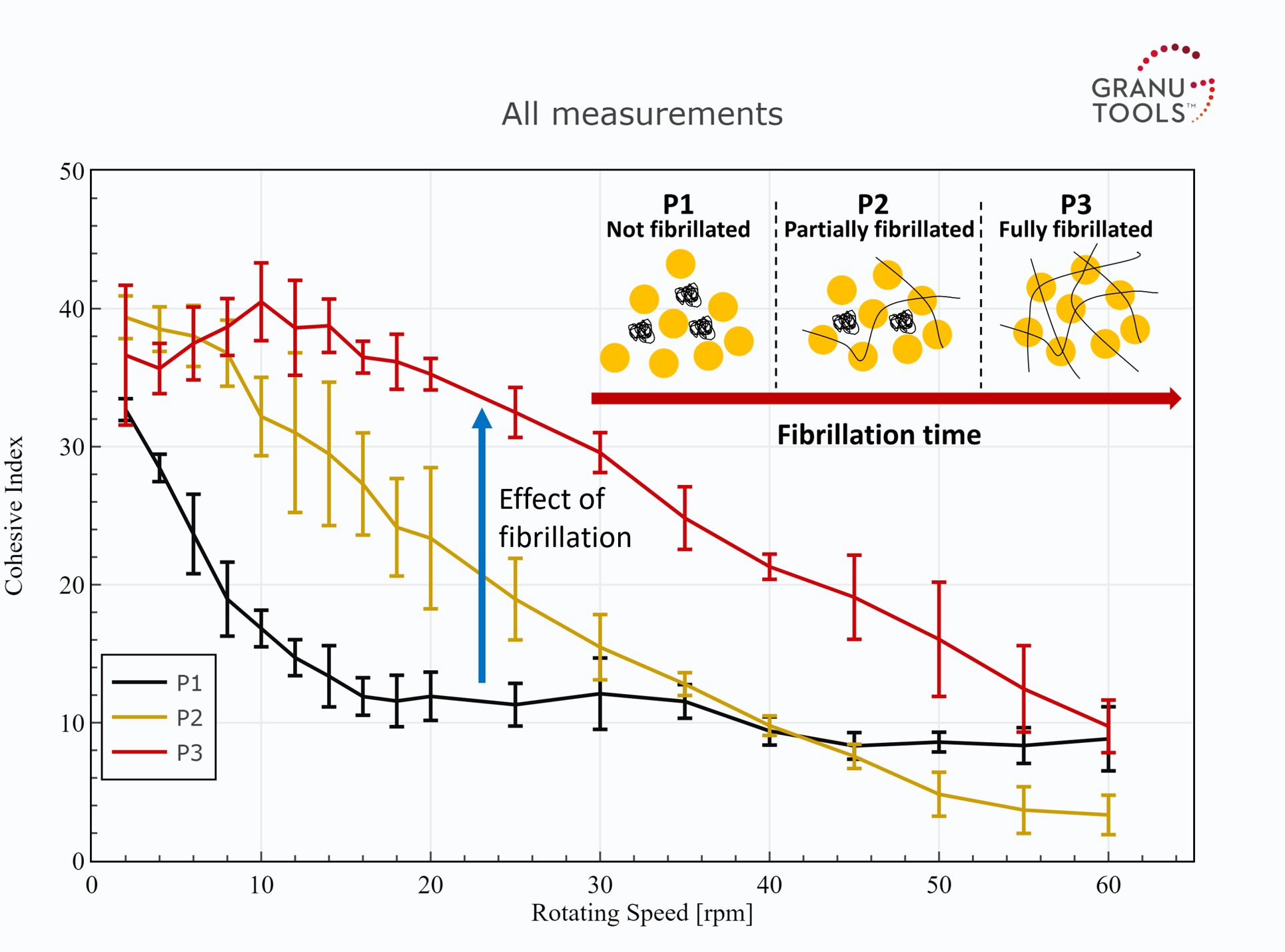 Figure 1: Dynamic Cohesive Index as a function of rotating speed for three batches at different levels of fibrillation.
Why Evaluate the DCI at 20 rpm?
Although fibrillation influences the Dynamic Cohesive Index across the entire speed range, the differences between samples are not equally pronounced at all rotational speeds.
At very low rotational speeds (around 2 rpm), the sensitivity to fibrillation remains limited.
Similarly, at high rotational speeds (around 60 rpm), inertial effects tend to reduce the ability to distinguish between different fibrillation levels.
In contrast, intermediate rotational speeds typically provide the greatest discrimination between samples.
For PTFE-based dry electrode formulations, a rotational speed around 20 rpm often provides the highest sensitivity to fibrillation.
Consequently, the Dynamic Cohesive Index measured at 20 rpm can be used as a practical metric for comparing fibrillation levels.
Quantifying Fibrillation
The degree of fibrillation can be estimated using the Dynamic Cohesive Index measured at an intermediate rotational speed: DCI at 20 rpm.
A higher DCI value indicates:
- Stronger particle entanglement
- Greater restriction of particle mobility
- A more developed fibrillar network
- A higher level of fibrillation
Conversely, a lower DCI value suggests that fibrillation remains limited and that particle mobility is less constrained.
Because the metric is derived from a dynamic flow measurement, it provides a simple and reproducible way to compare different processing conditions.
Optimizing Dry Electrode Manufacturing
The protocol can be used to investigate the impact of several process parameters, including:
- Fibrillation time
- Processing temperature
- Shear rate
- Mixing conditions
- Binder formulation
By systematically varying one parameter while keeping the others constant, users can identify the operating window that produces the desired fibrillation level.
This approach can improve process control and support the development of robust dry electrode manufacturing strategies.
Industrial Applications
Fibrillation measurements are particularly relevant for:
- Dry battery electrode manufacturing
- PTFE-containing powder formulations
- Energy storage materials
- Advanced functional materials
- Polymer-bonded powder systems
The method helps researchers and process engineers establish relationships between processing parameters, powder flow behavior, and final product performance.
Conclusion
The GranuDrum provides a simple and effective way to evaluate fibrillation in PTFE-containing powder blends.
As fibrillation increases, particle mobility decreases due to the development of an entangled fibrillar network, leading to higher Dynamic Cohesive Index values. This effect is particularly visible at intermediate rotational speeds, where the DCI can be used as a quantitative indicator of fibrillation.
By comparing the Dynamic Cohesive Index at approximately 20 rpm, users can assess and optimize fibrillation conditions for dry electrode manufacturing and other fibrillated powder systems.
For a more comprehensive evaluation of fibrillation, the GranuDrum results can be complemented by packing dynamics measurements performed with the GranuPack. While GranuDrum assesses the impact of fibrillation on powder flowability and cohesion through the Dynamic Cohesive Index, GranuPack quantifies the reduction in particle mobility through the packing dynamic parameter α. This complementary approach is detailed in the article “How to Evaluate Fibrillation with GranuPack?”.
FAQ – Evaluating Powder Fibrillation with the GranuDrum
What is powder fibrillation?
Fibrillation is the transformation of polymer agglomerates, such as PTFE, into elongated fibrils that create an interconnected network within a powder blend.
Why does fibrillation affect powder flowability?
The fibrillar network restricts particle mobility and increases particle interactions, resulting in higher powder cohesion.
Why is the Dynamic Cohesive Index often evaluated at 20 rpm?
Intermediate rotational speeds typically provide the highest sensitivity to fibrillation, making differences between samples easier to detect.
Can fibrillation parameters other than time be investigated?
Yes. Temperature, shear rate, mixing intensity, and formulation variables can be evaluated by comparing the resulting Dynamic Cohesive Index values.
What does a higher Dynamic Cohesive Index indicate?
A higher Dynamic Cohesive Index indicates stronger particle entanglement, lower particle mobility, and a more developed fibrillar network.