

Solution guides
How to evaluate caking with the GranuDrum?
Caking is a common phenomenon that can significantly impact powder handling, storage, and processing.
During storage, particles may form solid bridges with one another, leading to agglomeration and a reduction in flowability. In severe cases, caking can cause blockages, poor feeding performance, inconsistent dosing, and production downtime.
Evaluating a powder's tendency to cake is therefore essential for industries handling powders, including food, pharmaceuticals, chemicals, batteries, and additive manufacturing materials.
This article presents a practical method for investigating caking using the GranuDrum and its dedicated caking kit. Beyond detecting caking, the protocol also allows users to assess whether the powder can recover its original flowability after mechanical handling.
Why Measure Powder Caking?
Powders rarely remain unchanged during storage. Environmental conditions such as humidity, temperature, consolidation pressure, and storage time can progressively modify particle interactions.
As a result, a free-flowing powder may become significantly more cohesive after days, weeks, or months of storage.
A useful caking characterization method should therefore answer two important questions:
- How much cohesion is generated during storage?
- Can the powder recover its original flowability after being mechanically disturbed?
The GranuDrum provides a direct way to quantify both effects through the measurement of the Dynamic Cohesive Index.
Simulating Storage-Induced Caking
The GranuDrum caking kit enables powders to be stored under controlled conditions while applying a defined mechanical load.
A powder sample is placed inside the caking kit and subjected to a constant pressure during a predefined Storage Time. During this period, particle rearrangement and bridge formation may occur, progressively increasing cohesion within the powder bed.
By repeating the experiment for different Storage Times, the evolution of caking can be monitored and quantified.
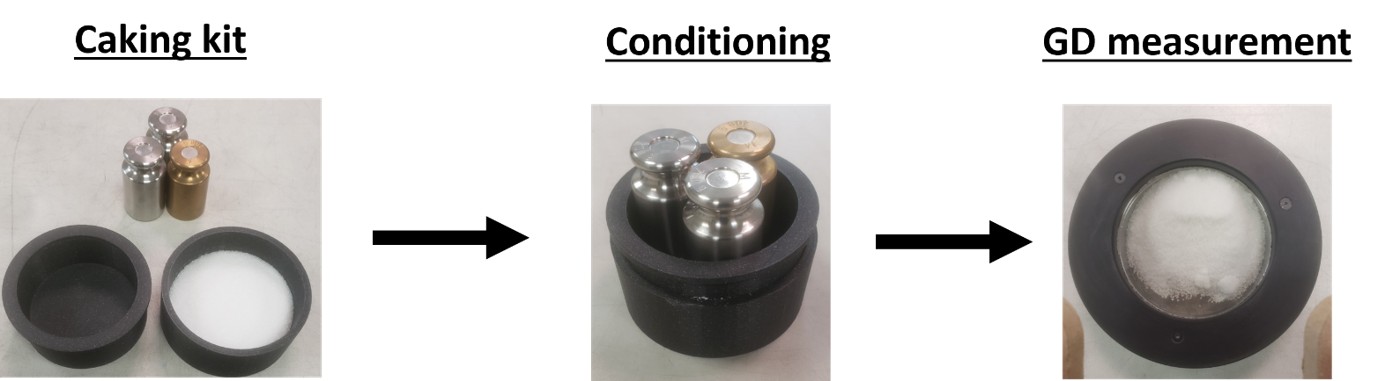
Figure 1: Picture of the caking protocol with the caking kit.
Characterizing the Caked Powder
After storage, the conditioned powder is carefully transferred into the GranuDrum measurement cell while preserving any agglomerates formed during storage. The GranuDrum test is then performed using both:
- An increasing rotating-speed sequence
- A decreasing rotating-speed sequence
This hysteresis measurement is particularly valuable because it provides information not only about the caked state of the powder but also about its recovery after mechanical agitation.
As the drum rotates, mechanical energy progressively breaks the solid bridges formed during storage, allowing the evolution of cohesion to be monitored in real time.
Understanding the Dynamic Cohesive Index
The Dynamic Cohesive Index (σ) is used to quantify powder cohesion.
Figure 2 shows the evolution of the Dynamic Cohesive Index as a function of the rotating speed for different storage times. The measurement performed without storage can be considered as the reference (non-caked powder).
After storage in the caking kit, the powder typically exhibits a higher Dynamic Cohesive Index at low rotational speeds, indicating the formation of solid bridges between particles and an increase in cohesion.
This increase can be quantified using the following metric:
where:
- σcaked inc (2rpm) is the Dynamic Cohesive Index measured at 2 rpm during the increasing-speed sequence after storage;
- σnot−caked inc (2rpm) is the Dynamic Cohesive Index measured at 2 rpm for the reference powder.
A larger Δσcaking indicates stronger interparticle bridges, higher cohesion, and a higher caking propensity.
Assessing Flowability Recovery After Mechanical Handling
One advantage of the GranuDrum hysteresis mode is the ability to evaluate whether caking is reversible.
As rotational speed increases, mechanical forces progressively break solid bridges. If the powder subsequently recovers its initial flowability, the cohesion measured during the decreasing-speed sequence will approach the value of the original non-caked powder.
The recovery can be quantified using:
Δσrecover = σcakeddec (2 rpm) − σnot-caked inc (2 rpm)
where:
- σcakeddec (2 rpm) is the Dynamic Cohesive Index measured at 2 rpm during the decreasing-speed sequence;
- σnot-caked inc (2 rpm) is the Dynamic Cohesive Index of the reference powder.
A low Δσrecover value indicates that most of the solid bridges formed during storage have been broken during the measurement and that the powder has recovered its original flowability. Conversely, a high Δσrecover value suggests that part of the agglomerated structure remains intact and that the caking is only partially reversible.
Consequently, Δσcaking can be used as a quantitative metric of caking intensity, while Δσrecover provides information on the ability of the powder to recover its initial flowability after mechanical handling.
Example: Granulated Sugar
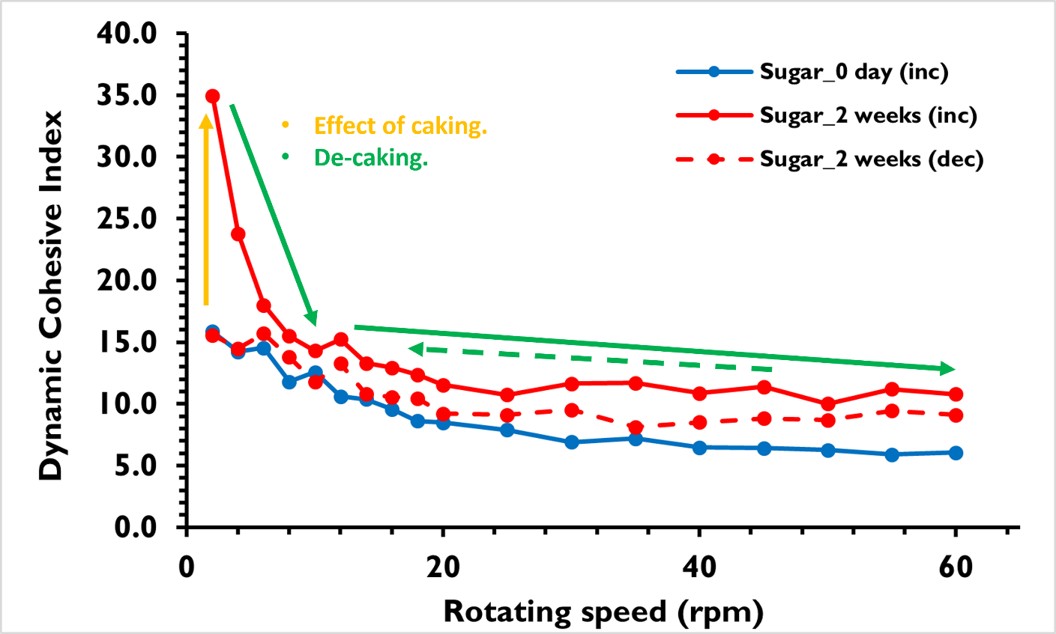
Figure 2: Effect of the caking on the powder cohesion.
Granulated sugar provides an illustrative example of caking behavior.
After two weeks of storage under load, the Dynamic Cohesive Index measured at 2 rpm increases significantly compared with the fresh powder. This increase reflects the formation of solid bridges between particles and corresponds to a Δσcaking value of 20, indicating significant caking.
As the rotating speed increases, these bridges progressively break down. During the decreasing-speed sequence, the cohesion returns to the initial value measured on the non-caked powder. Consequently,
Δσrecover equals 0, meaning that the powder fully recovered its initial flow properties after mechanical agitation.
In this case:
- The powder exhibits measurable caking during storage.
- The resulting caking remains fully reversible under mechanical agitation.
Investigating Storage Conditions
The protocol can be adapted to study the influence of multiple storage variables, including:
- Storage duration
- Relative humidity
- Temperature
- Applied consolidation load
- Environmental atmosphere
By systematically varying these parameters, users can identify the conditions that promote or mitigate caking and establish optimal storage practices.
Industrial Applications
Caking evaluation is particularly relevant for:
- Food ingredients and sugars
- Pharmaceutical powders
- Dairy powders
- Battery materials
- Additive manufacturing feedstocks
- Fertilizers
- Fine chemicals
The method helps manufacturers predict storage stability and determine whether powders will remain processable after prolonged storage.
Conclusion
The GranuDrum caking protocol provides a quantitative method to investigate storage-induced caking and its impact on powder flowability.
Using the Dynamic Cohesive Index measured in hysteresis mode, users can quantify caking through the parameter Δσcaking and evaluate recovery after mechanical handling through Δσrecover.
In addition to detecting caking, the method helps determine whether a powder can regain its original flowability, providing valuable information for storage, transportation, and processing applications.
FAQ – Powder Caking Evaluation with the GranuDrum
What is powder caking?
Caking is the formation of solid bridges between particles during storage, resulting in increased cohesion and reduced powder flowability.
Why is the Dynamic Cohesive Index measured at low rotational speed?
Low rotational speeds are more sensitive to interparticle forces, making cohesion changes caused by caking easier to detect and quantify.
Can a caked powder recover its original flowability?
Yes. Mechanical agitation can break the solid bridges formed during storage, partially or completely restoring the original flow properties.
Which storage parameters can influence caking?
Storage time, humidity, temperature, consolidation pressure, and particle properties can all affect the development of caking.
What does a high Δσcaking value indicate?
A high Δσcaking value indicates stronger particle bonding, higher cohesion, and a greater propensity for the powder to cake during storage.