
Solution guides
How to evaluate the propensity of a powder to keep accumulated electrostatic charge with GranuCharge?
Electrostatic charging is a frequent challenge in powder handling operations. During conveying, blending, filling, or transfer processes, particles repeatedly come into contact with equipment surfaces and with one another, generating electrostatic charges through triboelectric interactions.
While electrostatic charging does not always immediately affect powder flowability, retained charges can create significant issues downstream. Powders that are unable to dissipate the generated charges may experience handling difficulties, segregation, wall adhesion, inaccurate dosing, or increased risks in sensitive manufacturing environments.
For this reason, understanding not only how a powder becomes charged but also how long it retains accumulated electrostatic charge is essential. The GranuCharge provides a practical method for evaluating the ability of powders to dissipate or retain electrostatic charges after repeated handling events.
Why Measure Electrostatic Charge Retention?
Most electrostatic measurements focus on the amount of charge generated during a single handling event. However, industrial processes often involve multiple transfers, conveying steps, or recirculation loops.
In such situations, two powders may behave very differently:
- One powder may rapidly dissipate charges between successive handling operations.
- Another powder may progressively accumulate charge over time.
The second case can lead to increasing electrostatic effects throughout the process, even when each individual transfer generates only a moderate amount of charge.
Evaluating charge retention therefore provides valuable information about the electrostatic stability of a powder during continuous processing.
Assessing Charge Accumulation Through Repeated Flows
The principle of the method is straightforward: a single powder sample is subjected to successive GranuCharge measurements performed one after another without interruption.
The first measurement establishes a reference condition and quantifies the charge generated after the initial flow through the measurement system.
Subsequent measurements are then performed using exactly the same powder sample while bypassing the initial charge determination. This allows the operator to monitor whether electrostatic charges continue to accumulate from one flow event to the next.
Because the same sample is reused throughout the experiment, any increase in measured charge reflects the powder's inability to dissipate previously accumulated electrostatic charges.
Interpreting the Results
The key parameter to monitor is the final charge measured after each consecutive run.
A powder that efficiently dissipates electrostatic charge will typically exhibit similar charge levels from one run to the next. Although charging occurs during each flow event, the previously accumulated charge disappears before the following measurement.
In contrast, a powder with poor charge dissipation properties will show a progressive increase in charge over successive runs. The charge generated during earlier flows remains partially trapped within the powder and adds to the charge generated during later flows.
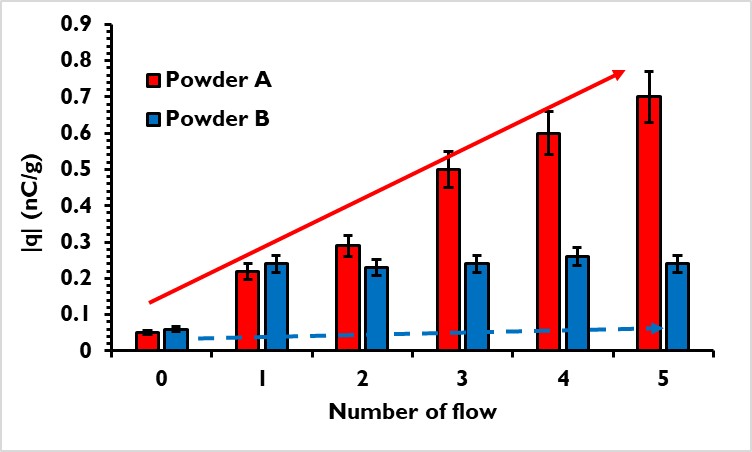
Figure 1: Accumulated electrostatic charge, in absolute value, as a function of the number of run in the pipes.
Example: Comparing Two Powders
Figure 1 illustrates two typical behaviors.
Powder A: Charge Retention
For Powder A, the absolute charge density increases continuously from one run to the next. This behavior indicates that the powder cannot dissipate its accumulated charge quickly enough between measurements.
As a result, electrostatic charge progressively builds up throughout the experiment.
Powder B: Charge Dissipation
Powder B initially becomes charged during the first flow. However, subsequent measurements remain relatively constant.
This behavior indicates that although the powder is capable of generating electrostatic charge, it is also able to dissipate that charge efficiently between successive flow events.
Consequently, no significant charge accumulation occurs over time.
Practical Considerations
Several factors can influence electrostatic retention measurements:
- Relative humidity
- Ambient temperature
- Powder moisture content
- Particle size distribution
- Material conductivity
- Surface chemistry
To obtain meaningful comparisons, testing conditions should remain constant throughout the experiment.
Repeating the complete procedure multiple times also helps assess measurement repeatability and increases confidence in the observed trends.
Industrial Applications
Charge-retention measurements can be particularly useful for:
- Pharmaceutical powders
- Additive manufacturing feedstocks
- Battery materials
- Fine chemicals
- Food ingredients
- Polymer powders
The method helps identify powders that may develop electrostatic issues during repeated handling, transportation, or recirculation steps.
Conclusion
Electrostatic charge generation alone does not fully describe powder electrostatic behavior. The ability of a powder to dissipate accumulated charge is equally important for predicting its performance during industrial processing.
By performing successive GranuCharge measurements on the same sample, users can determine whether electrostatic charges accumulate or dissipate over time. A progressive increase in charge indicates poor charge dissipation capability, whereas stable charge levels suggest efficient electrostatic relaxation.
This protocol provides a simple and effective way to assess electrostatic charge retention and to compare the electrostatic stability of different powder materials.
FAQ – Electrostatic Charge Retention of Powders
What is electrostatic charge retention in powders?
Electrostatic charge retention describes the ability of a powder to keep accumulated electrical charges instead of dissipating them over time.
Why is charge retention important in powder processing?
High charge retention can cause handling issues such as wall adhesion, poor dosing accuracy, segregation, and unstable powder flow during processing.
Can a powder generate charge without retaining it?
Yes. Some powders become charged during flow but dissipate the generated charge rapidly, preventing long-term accumulation.
Which powder properties influence electrostatic charge retention?
Electrical conductivity, moisture content, particle size, surface chemistry, and material composition can influence charge dissipation behavior.
How can different powders be compared using this method?
The evolution of charge measured over successive runs can be compared to identify materials that dissipate charge rapidly and those that progressively accumulate charge.