
Papers
How Single Crystal Content Affects Powder Porosity and Flow in Dry Electrode Coating
Nickl, M. et al., The interdependence of single crystal content and polytetrafluoroethylene fibrillation in dry-coated nickel-rich lithium-ion cathodes, Journal of Energy Storage 148 (2026) 120316. https://doi.org/10.1016/j.est.2025.120316
Single crystal NMC particles are mechanically more robust than their polycrystalline counterparts, which is why they attract interest for nickel-rich cathodes. What happens when they meet a solvent-free process is a different question, and one that has received far less attention.
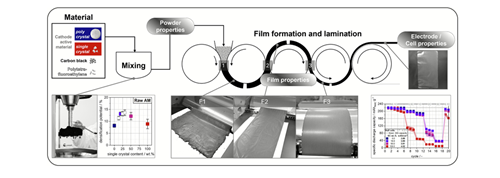
A new open-access study from TU Braunschweig and the Battery LabFactory Braunschweig addresses it directly. The authors blend single crystal (SC) and polycrystal (PC) NMC at four ratios, keep the mixing protocol strictly constant, and track how the blend behaves from raw powder through PTFE fibrillation to a calendered electrode. Bulk and tapped densities were measured with a GranuPack, alongside mercury intrusion porosimetry, uniaxial compaction and ring shear testing.
The intuition that does not survive contact with the data
The starting hypothesis is a familiar one from powder technology: fine particles should fill the interstitial voids between coarse ones and raise the packing density. The SC particles here are around 3 to 6 µm, the PC particles around 10 to 12 µm, and a simple void-filling calculation predicts an optimal SC fraction of roughly 18.9 wt%.
The measurements contradict the mechanism while partly supporting the number. Bulk porosity of the raw blends rises steeply with SC content, from about 50 % for pure PC to about 80 % for pure SC, and the mixed blends show no packing advantage over the raw materials. Rather than filling voids, the fine SC particles agglomerate and adhere to the PC surfaces through van der Waals interactions. The size ratio between the two populations is simply too small for effective void filling.
Tapped porosity rises less steeply than bulk porosity, which tells its own story: mechanical compaction partially breaks these agglomerates apart and returns the packing to something governed by particle geometry.
Reading the packing curve, not just the endpoint
The GranuPack measurements were run under ambient conditions with 1500 taps at 1 Hz, averaged over three replicates, recording density as a function of tap number rather than a single endpoint value.
From that curve the authors derive a metric they call the absolute densification potential: the difference between tapped porosity and bulk porosity, representing the fraction of air that tapping removes. It peaks at intermediate SC contents, around 31.4 wt% on the raw data, although the authors are careful to note that the error bars at 18.9 and 25 wt% are comparable and that the maximum should be read with caution.
This is a useful reminder that a packing curve carries more information than the two densities at its ends. How a powder gets from loose to dense says something about the agglomerate structure that the final density alone does not.
The ranking reverses under pressure
The most instructive part of the study is a comparison the authors make deliberately: the same blends, characterised at four different pressure levels along the process chain.
At zero or low pressure, measured by GranuPack and by shear cell, bulk porosity increases with SC content. Under uniaxial loading at 8.83 MPa, the trend reverses, and the SC/PC blends show lower porosity than the pure materials thanks to more effective particle rearrangement. At tablet compaction pressures of 70 MPa, close to the roughly 65 MPa estimated during initial film formation in the calender, the advantage of the blends becomes clear, and the 18.9 wt% formulation shows the lowest porosity in the final structure. After lamination onto aluminium foil at around 136 MPa, porosity reaches its minimum.
The practical consequence is worth stating plainly. Low-pressure characterisation describes the powder as it is stored, conveyed and fed into the calender gap, before full compaction. It does not, on its own, predict the porosity of the finished electrode, and the study shows a case where it points in the opposite direction. Both measurement domains are needed, and knowing which one a given method occupies is part of interpreting it correctly.
Flow behaviour and film thickness
Increasing SC content reduces flowability, as shown by the density-weighted flow function coefficient, and raises the internal friction angle. The mechanism the authors propose is a loss of lubrication: with reduced fibril formation, PTFE adheres poorly to the smooth SC surfaces, and the higher specific surface area of the fine particles strengthens van der Waals interactions.
The wall friction angle turns out to be the more operationally useful parameter. Higher wall friction promotes material retention in the calender gap and produces thicker films, and the study confirms that it reliably predicts film thickness trends after the initial powder-to-film step.
Notably, the PC-rich mixtures flow better despite forming coarser fibril structures that would normally increase cohesion. Particle size and shape, in other words, can outweigh the cohesion contributed by the fibril network.
Where the optimum sits, and why
Pure SC powder failed to process properly. Its low bulk density means a high free volume between particles, the mixer transmits insufficient shear, and PTFE fibrillation never develops. The resulting film could be calendered only once, was too fragile for repeated tensile testing, and produced electrodes with roughly twice the resistivity of the others.
The 18.9 wt% blend gave the lowest porosity in the final structure, the highest electrode density at comparable areal capacity, the best rate capability up to 3C, and a volumetric energy density of about 2200 Wh/L at 0.1C.
The authors are explicit about the boundaries of that result. It holds for a constant mixer fill level, fixed carbon black and binder contents, and a single mixing protocol. SC-rich blends may well perform differently with more binder, more conductive additive, or a mixing route adapted to their higher specific surface area.
Why this matters for dry electrode development
For anyone formulating dry-coated cathodes, the study makes a concrete point about characterisation strategy: the pressure at which a powder property is measured determines what that property can predict. Bulk porosity from a packing curve describes handling and feeding. Compaction data describes the electrode that comes out of the gap. Treating either as a proxy for the other can invert the conclusion.
Reference
M. Nickl, T. Grenda, P. Michalowski, A. Kwade, The interdependence of single crystal content and polytetrafluoroethylene fibrillation in dry-coated nickel-rich lithium-ion cathodes, Journal of Energy Storage 148 (2026) 120316. https://doi.org/10.1016/j.est.2025.120316
Abstract
This study investigates the role of fine single crystal (SC) particles as cathode active material (CAM) in blends with polycrystal (PC) CAM particles for Polytetrafluoroethylene (PTFE) fibrillation, processing, and performance in thin dry-coated, nickel-rich cathodes (~60 μm, 3.9 mAh cm−2, 1.5 wt% PTFE). Pure SC powders show high bulk porosity and, under the same fill level and mixing protocol, exhibit a higher specific mixing energy (~300 kJ kg−1), resulting in functional but insufficiently fibrillated electrodes. However, theoretical considerations indicate that a moderate SC fraction of about 18.9 wt% can fill PC voids during high compaction, resulting in denser electrodes with finer PTFE fibrillation, which results in a more homogenous electrode structure. Powder flow measurements show that wall-friction angles correlate with film thickness during the initial film formation step. Calendering further refines PTFE fibrils, increases tensile strength of free-standing films, and decreases electrical electrode resistivity, probably by releasing carbon black embedded within PTFE. Within the investigated parameter window and electrode designs, cathodes with the theoretically derived 18.9 wt% fraction exhibit balanced properties and the highest energy density (~2200 Wh L−1 at 0.1C). The findings provide practical guidance for tailoring SC/PC blends and processing parameters in advanced dry-coated nickel-rich cathodes.
Frequently Asked Questions
How is bulk porosity calculated from powder density measurements?
Bulk porosity is derived from the ratio of measured bulk density to the true density of the material, expressed as the fraction of the bulk volume occupied by voids. True density is typically obtained by helium gas pycnometry, which accesses the solid skeleton volume without the interparticle space.
What is a powder packing curve?
A packing curve records density as a function of the number of taps applied, rather than reporting only initial and final values. Its shape reflects how quickly a powder rearranges and how much air can be removed by mechanical agitation, which distinguishes materials that reach comparable final densities by different routes.
What distinguishes single crystal from polycrystal NMC cathode material?
Polycrystal particles are agglomerates of primary grains separated by grain boundaries, where mechanical stress during lithium intercalation can initiate intergranular cracking. Single crystal particles have no grain boundaries and undergo nearly isotropic volume changes, which improves mechanical integrity. They are typically smaller and exhibit a higher specific surface area.
What is the wall friction angle and why does it matter in calendering?
The wall friction angle quantifies the resistance to shear between a powder and a defined wall material, obtained from the slope of the wall yield locus in a shear cell. In roll-based processes it governs how strongly material is retained in the gap, and therefore correlates with the thickness of the film formed during the first calendering pass.
Why does active material morphology influence PTFE fibrillation?
Fibrillation depends on shear transmitted between particles during mixing. Particle size, shape, surface area and bulk porosity all affect how efficiently that shear reaches the binder. Powders with low bulk density leave a high free volume at a given fill level, which reduces particle-particle contact and can leave the binder insufficiently fibrillated.