
Papers
Comparing Powder Flowability Methods for Dry Electrode Coating
Lux, M. et al., Process-property relationships in dry powder extrusion and dry electrode coating of lithium-iron-phosphate cathodes, Powder Technology 476 (2026) 122401. https://doi.org/10.1016/j.powtec.2026.122401
Dry electrode coating removes the solvent, the drying ovens and a large share of the energy bill from lithium-ion battery manufacturing. It also removes the parameter engineers have relied on for decades to judge whether a batch is fit to coat. In slurry processing, viscosity tells you almost everything. In dry processing, there is no equivalent.
A new open-access study from Fraunhofer IWS, Bühler Group and TU Dresden addresses this gap directly. Working on lithium-iron-phosphate cathodes, the authors compare three powder flowability characterisation methods across six mixing intensities, and show that each one answers a different question about the same material. Bulk and tapped density were measured with a GranuPack, and cohesive index with a GranuDrum.
No established flowability standard for dry electrode powders
The authors state the problem plainly: for dry electrode coating, no flowability characterisation method has yet been established as a reference. This is not a minor gap. The granules produced by dry mixing have to be stored, fed into a calender, and sheared inside the roll gap, and each of those steps stresses the material in a completely different way.
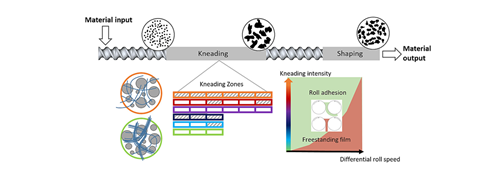
To probe this, the team produced granules from a single formulation (95 wt.-% LFP, 3.5 wt.-% carbon black, 1.5 wt.-% PTFE) using six twin-screw extruder configurations. Only the screw geometry changed, giving a specific mechanical energy input ranging from 193 to 531 kJ/kg. Higher energy input means stronger PTFE fibrillation, finer fibril networks, smaller and more spherical granules.
Six materials, chemically identical, physically very different. An ideal test set for a comparison of characterisation methods.
One method per process step
Three flowability indicators were measured on every batch:
- Hausner ratio, from bulk and tapped density measured with a GranuPack. The powder is tapped 2000 times at 2 Hz while a laser tracks the height of the powder bed. The material densifies freely, with no external load.
- Cohesive index, measured with a GranuDrum. The powder is rotated in a transparent drum at a range of speeds while a camera records the powder-air interface. The index is derived from the fluctuations of that interface. Again, no external load, but the material is in motion.
- Flow function coefficient (ffc), measured in a ring shear cell under normal loads of 5 and 15 kPa. Here the powder is strongly compacted while it is sheared.
The authors are explicit that these differences in stress state matter, and they map each indicator onto a stage of the process chain: the Hausner ratio describes compaction behaviour during long-term storage, the cohesive index is relevant to feeding and conveying material into the calender gap, and the ffc describes what happens inside the gap, where the granules are compressed and sheared at the same time.
What the measurements showed
The three methods did not respond in the same way to the six mixing histories.
The Hausner ratio stayed between 1.20 and 1.23 across every batch, a fair flowability rating throughout. Taken alone, it would suggest six equivalent materials. The bulk and tapped densities behind it did shift, both rising by roughly 0.1 g/ml from the softest to the strongest kneading, reflecting the smaller and more spherical granules produced at high energy input.
The cohesive index separated the batches clearly. Granules from the three low-intensity screws (190 to 290 kJ/kg) sat between 20 and 25, a passable flowability. Granules from the three high-intensity screws (380 to 530 kJ/kg) fell to between 14 and 20, a fair flowability. The trend held across all drum rotational speeds tested, and drum speed itself had no significant influence on the result.
The ffc followed the same direction, but only under high normal load: at 15 kPa it climbed from 4 (cohesive) to 12 (free flowing), while at 5 kPa it was almost flat across all six materials.
The authors relate the cohesive index trend to granule macrostructure. Softly kneaded granules have lower sphericity and rougher surfaces, offering more opportunities for interlocking, while more spherical granules slide past one another more easily under rotation.
From granule properties to electrode quality
The study then follows the same six materials through DRYtraec® calendering. Granules that flowed better were easier to process: the window of shearing ratios giving proper adhesion to the calender roll widened with kneading intensity, thinner electrodes could be reached in a single calendering step, and adhesion strength improved.
The trade-off appeared downstream. Strong fibrillation also raised electrical resistivity, both in the granules and in the finished electrodes, and thick electrodes made from the most intensely kneaded material lost rate capability, delivering around 72 mAh/g at 3C against 96 mAh/g for the softest mixing.
The authors conclude that an optimum exists rather than a maximum, and place it at roughly 350 to 400 kJ/kg for this particular formulation.
Why this matters for dry electrode manufacturing
The practical message of the study is that a single flowability number cannot qualify a dry electrode powder. A material can look unchanged under tapping and behave very differently under rotation or under shear, and the relevant measurement depends on which step of the process chain is being predicted.
For anyone scaling a dry coating line, this argues for characterising granules with methods matched to the stresses they will actually experience: compaction during storage, flow during feeding, shear inside the calender gap.
Reference
M. Lux, C. Hänsel, A. Dupuy, C. Girsule, B. Schumm, S. Kaskel, C. Leyens, Process-property relationships in dry powder extrusion and dry electrode coating of lithium-iron-phosphate cathodes, Powder Technology 476 (2026) 122401. https://doi.org/10.1016/j.powtec.2026.122401
Abstract
This study investigates correlations between the process steps of dry mixing and dry electrode coating for lithium‑iron-phosphate (LFP) cathodes. Active material, conductive additive and PTFE binder were mixed in a continuous twin-screw extrusion process at different intensities via variation of the screw configuration. Suitable characterization methods for the dry mixed powders were applied to conclude on process-property relationships between kneading intensity and granule properties. Intensive kneading with a high specific mechanical energy input resulted in a more homogeneous and fine PTFE fibril network and in more compact and size-reduced granules. These differences in micro- and macrostructure lead to a higher electrical resistivity, higher bulk density and better flowability. The processing window concerning the applicable roll shearing ratio for one-step calendering in the DRYtraec® process broadened for high kneading intensity compared to softer kneading. Thinner electrodes could be obtained due to the higher sensitivity of a fine PTFE fibril network to shearing forces within the calender gap. Resulting electrodes demonstrated a higher adhesion strength and higher electrical resistivity as well as slight breakage of LFP particles and a lower C-rate performance. These results provide detailed insights into the dry processing chain of LFP mixtures including intermediate products and their processability, highlighting the importance of understanding the correlation between different dry coating process steps. With extrusion mixing it is possible to tailor granule properties concerning their processability, electrode structure and electrochemical performance via applying an optimal amount of mechanical energy during mixing for each specific material system.
Frequently Asked Questions
How is the Hausner ratio defined?
The Hausner ratio is the dimensionless ratio of tapped density to bulk density. Bulk density is measured on a freely settled powder bed, tapped density after a defined number of taps at a fixed frequency. Values close to 1 indicate limited densification and good flow, while values above 1.35 indicate poor flow.
Why can two powders with the same Hausner ratio behave differently in a process?
The Hausner ratio characterises densification under repeated tapping, a low-stress, gravity-driven rearrangement. It does not capture interparticle cohesion under continuous motion, nor internal friction under an applied normal load. Powders with comparable packing behaviour can therefore differ substantially during conveying, feeding or shearing.
Why is PTFE used as a binder in dry electrode coating?
Under shear and elevated temperature, PTFE fibrillates into a fibre network that mechanically supports the electrode film without any solvent. The mechanism is efficient enough that binder contents down to 0.1 wt.-% can be sufficient to form self-supporting films, and fibrillation is typically promoted near the glass transition of PTFE, around 110 to 130 °C.
How does granule size distribution affect dry electrode film formation?
Oversized granules can produce inconsistencies or pinholes in the coated film, since they are not fully deformed within the calender gap. Smaller or bimodal distributions increase bulk density and improve feeding regularity, but also raise compaction forces in the gap. Granule size is therefore a processability parameter in its own right, not only a mixing outcome.
What is the DRYtraec® process?
DRYtraec® is a calender-based dry coating process developed at Fraunhofer IWS. Two counter-rotating rolls run at different speeds, and the resulting shear forms a thin electrode film in a single step. The film adheres to the faster roll and can be laminated directly onto the current collector, removing the multiple calendering passes required by earlier dry coating routes.