
Blog
3D Reconstruction of the Powder Heap with the GranuHeap
The Angle of Repose has always been measured from a single picture of a powder heap, and that single point of view is where the measurement loses its reliability. The GranuHeap records the heap from several angles, averages them into one value and rebuilds the heap in three dimensions.
The Angle of Repose and the Limits of a Single-Picture Measurement
The Angle of Repose (AOR) is one of the oldest and most widely used methods to characterize powder flowability. When poured onto a flat surface, a powder naturally forms a heap, and the steepness of its slope reflects the balance between inter-particle friction and cohesive forces: a low, flat heap is typical of a free-flowing powder, while a tall, steep heap points to a more cohesive one. Traditionally, however, the Angle of Repose is measured from a single picture of the heap, taken from one single point of view. Because real powder heaps are rarely perfectly symmetric, this approach is highly sensitive to the exact position of the camera, or of the operator's eye: a local bulge, an off-centre apex or a small avalanche on one side of the heap can bias the measured angle, and two operators looking at the same heap from different sides can report two different values.
Multi-Viewpoint Acquisition: a More Repeatable Angle of Repose
The GranuHeap software addresses this limitation with a multi-viewpoint acquisition. Instead of relying on a single picture, the instrument records the heap from several points of view around its base and combines them into a single, averaged measurement of the Angle of Repose. By no longer depending on where the camera, or the operator, happens to be looking, this approach removes a major source of bias and considerably improves the repeatability of the measurement, whatever the shape of the powder heap.
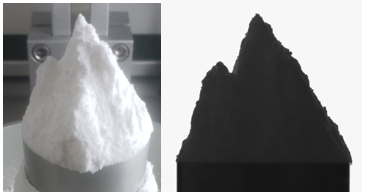 on the GranuHeap platform..png)
Fig. 1 - Heap of a cohesive pharmaceutical powder (glutamine) on the GranuHeap platform.
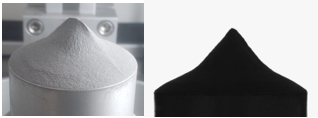
Fig. 2 - Heap of a free-flowing Ti6Al4V metal powder used in additive manufacturing.
3D Reconstruction of the Powder Heap
Combining several viewpoints does more than improve the accuracy of a single angle value: it gives the GranuHeap software everything it needs to reconstruct the entire heap in three dimensions. Rather than a flat silhouette, the operator obtains a full 3D model of the powder heap, which can be freely rotated, zoomed and inspected directly within the software.
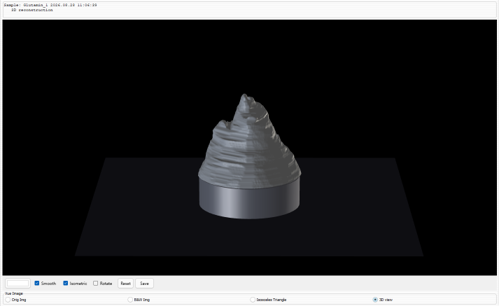
Fig. 3 - 3D reconstruction of the glutamine heap, built from multiple viewpoints.
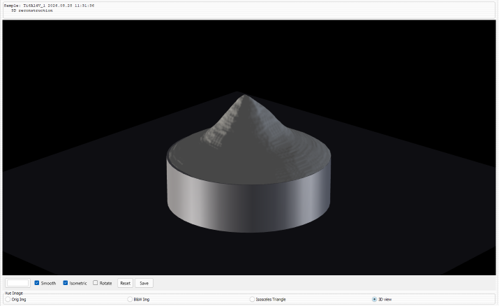
Fig. 4 - 3D reconstruction of the Ti6Al4V heap.
Conclusion: Seeing the Whole Heap, Not Just One Side
The multi-viewpoint acquisition of the GranuHeap provides a more precise, more repeatable Angle of Repose than any single-picture method, while its 3D reconstruction gives an unprecedented, intuitive view of how the powder actually behaves when poured.
Frequently Asked Questions
How is the powder heap formed in an automated angle of repose measurement?
An initialization tube with the same internal diameter as the cylindrical support is placed on the support and filled by hand with a fixed volume of powder, typically 100 ml. The tube then rises at a constant speed, letting the powder flow out to form the heap. Fixing the volume and the rising speed removes the operator's influence on how the heap is built, which is a prerequisite for a repeatable angle of repose.
Does the diameter of the support affect the measured angle of repose?
Yes. The support diameter is a parameter of the measurement, not a neutral detail, and its influence depends on how cohesive the powder is. Angles of repose obtained on different support diameters should therefore not be compared directly, and the diameter should be reported together with the result.
What is the static cohesive index?
It quantifies the deviation between the real heap interface and an ideal isosceles triangular heap. The index is computed for each image, that is for each heap orientation, and averaged over all orientations. It is close to zero for a non-cohesive powder and increases as inter-particle cohesive forces strengthen, which makes it a complement to the angle of repose rather than a substitute for it.
Which powder properties influence the angle of repose?
Mainly particle size and particle shape, together with the cohesive interactions between particles. The general trend is that a higher angle of repose corresponds to lower flowability, since a steep heap indicates high friction, high cohesion, or both.
Is the angle of repose covered by a standard?
Several standardized protocols describe the measurement, in particular USP 1174. The GranuHeap software integrates the USP1174 procedure and guides the operator through each step, while measurement data are stored electronically under 21 CFR Part 11 compliance for data integrity.