
Solution guides
How to Measure the Powder Fluidization Threshold with GranuPack?
This article presents a practical method for determining the minimum fluidization threshold of a powder, expressed both in pressure and in flow rate, using the GranuPack permeability measurement.
Introduction
The minimum fluidization threshold is a critical parameter in many industrial processes involving granular materials, including fluidized bed reactors, drying, coating, granulation, and catalytic operations.
At this threshold, the drag force exerted by the fluid phase balances the effective weight of the particle bed. The powder then transitions from a static packed state to a dynamic, fluid-like behaviour. This transition fundamentally alters the mechanical and transport properties of the system.
Because process performance depends directly on operating above or below this transition, robust and reliable methods for identifying the onset of fluidization are essential. The GranuPack permeability measurement provides such a method, by recording the pressure drop across a powder bed as a function of the flow rate.
Why Measure the Fluidization Threshold?
The behaviour of a powder bed crossed by a gas flow follows three successive regimes:
- Below the threshold: the bed remains static, the gas percolates through the pores, and the pressure drop increases linearly with the flow rate.
- At the threshold: the pressure applied to the grains by the fluid compensates their apparent weight, and the stress within the bed vanishes.
- Above the threshold: the pressure drop stabilises around a constant value with large fluctuations, and the bed behaves like a fluid.
Identifying the transition point between these regimes allows users to size blowers and distributors, define safe operating windows, avoid channelling or entrainment, and compare the fluidization behaviour of different powders or batches under identical conditions.
Preparing the Sample
The measurement starts with a standard GranuPack sample preparation.
- A volume of 35 ml of powder is used in the general case.
- For light powders that are easily projected out of the cell, a reduced volume of 20 ml or 10 ml is recommended.
- To characterise the powder in its loose state, the number of taps is set to the lowest value and the permeability sequence to 0.
- To characterise a consolidated state, the number of taps and the permeability sequence are set to a chosen value, selected according to the packing fraction that has to be reproduced.
The initial packing fraction has a direct influence on the measured threshold, so this choice should reflect the state of the powder in the actual process.
Recording the Empty-Cell Reference
The pressure drop measured during a permeability test does not come from the powder alone: the porous filter located at the bottom of the cell also contributes.
For this reason, a first acquisition is performed with the empty cell. The flow rate is increased step by step in order to obtain several points on the pressure drop versus flow rate curve. This reference curve is linear, and its slope characterises the intrinsic resistance of the cell.
Measuring the Powder Bed
The cell is then filled following the regular GranuPack procedure, and the same acquisition is repeated on the powder bed.
The flow rate is increased slowly, point by point, until fluidization becomes visible in the cell. A few additional points are acquired beyond this visual transition to clearly capture the plateau, and the flow is then closed.
At the end of the measurement, the raw data are exported to an Excel file, which contains both the empty-cell curve and the powder curve.
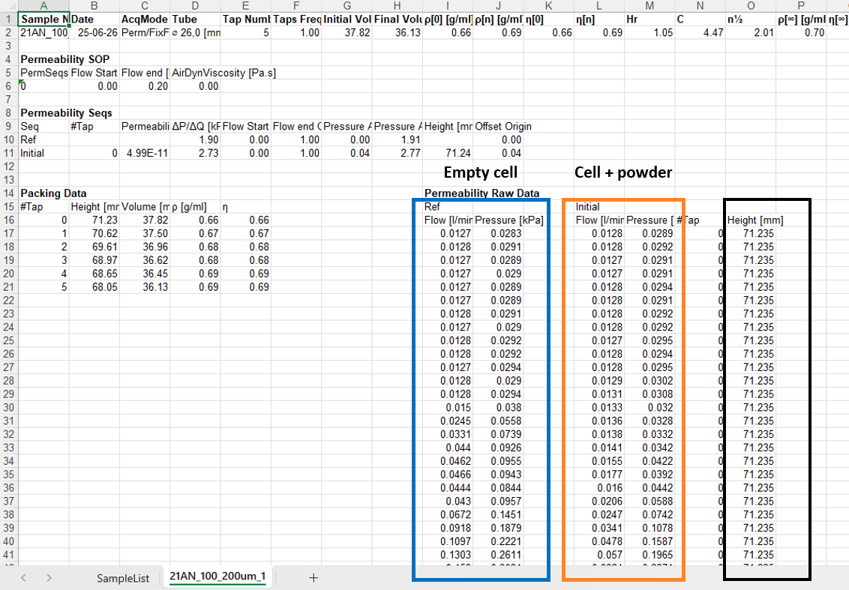
Figure 1: Excel file with the raw data needed.
Correcting the Pressure Drop
The contribution of the cell is removed by subtracting the reference curve from the measurement performed with powder:
Ppowder(Q) = Ppowder+cell(Q) − a * Q
where Ppowder is the corrected pressure drop coming from the powder only, Ppowder+cell the measured pressure drop, a the slope of the empty-cell curve, and Q the flow rate.
This correction isolates the powder contribution and makes the fluidization transition clearly visible.
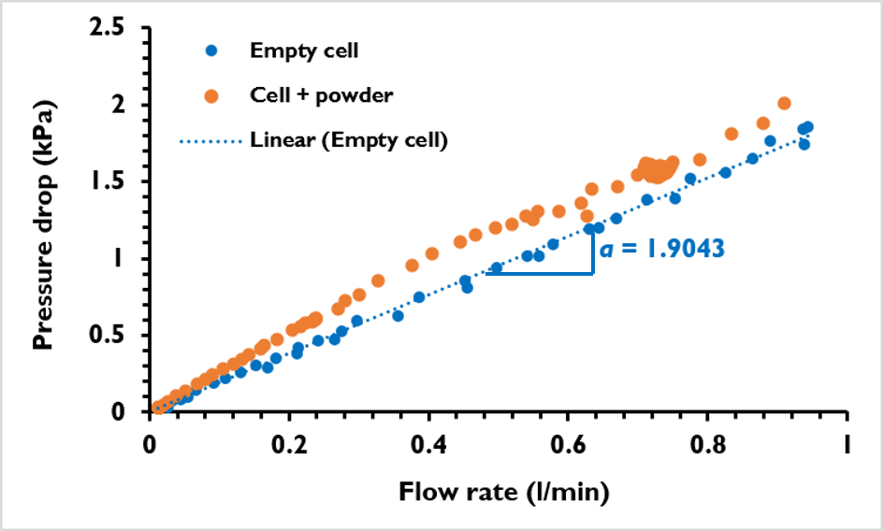
Figure 2: Pressure drop as a function of the flow rate for the empty cell and the cell filled with powder.
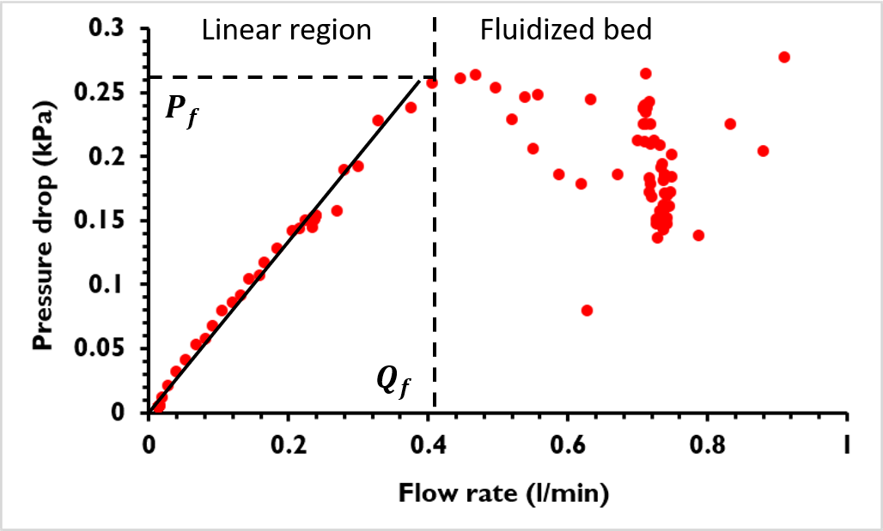
Figure 3: Corrected pressure drop versus the flow rate for the powder contribution only.
Identifying the Fluidization Threshold
On the corrected curve, the fluidization threshold corresponds to the transition point (Pf, Qf) at which the linear regime gives way to a constant regime showing large fluctuations.
- The linear part reflects the static packed bed, where the resistance to the flow increases with the flow rate.
- The plateau reflects the fluidized bed, where the pressure drop no longer increases because the grains are supported by the fluid.
- The fluctuations observed beyond the transition are characteristic of the dynamic rearrangement of the fluidized state.
Interpreting the Threshold
Fluidization occurs when the stress in the powder bed vanishes, meaning that the pressure applied to the grains by the fluid flow compensates their weight. This condition is expressed as:
Pf = η * (ρgrain − ρfluid) * g * h
where η is the packing fraction of the powder bed, ρgrain and ρfluid the true densities of the grains and of the fluid, g the gravitational acceleration, and h the height of the powder bed.
This relation shows that the pressure drop at fluidization depends on the height of the bed, and therefore on the geometry of the system in which the powder is handled.
Transposing the Results to an Industrial Process
Because the threshold depends on the geometry, the values measured with the GranuPack can be rescaled to the dimensions of the process.
When pressure is the control parameter:
Pf,process = (hprocess / hGranuPack) * Pf,GranuPack
When flow rate is the control parameter:
Qf,process = (Sprocess / SGranuPack) * Qf,GranuPack
where h is the height of the powder bed and S the surface of the porous distributor at the bottom of the fluidization system.
The pressure drop obtained in this way corresponds to the pressure difference applied to the powder itself, between the top and the bottom of the bed. It does not account for upstream elements such as porous media or gas piping of the reactor, whose contribution has to be evaluated separately by the operator.
Taking Consolidation into Account
The measured values of pressure and flow rate depend on the packing fraction of the powder bed.
- If the powder is not consolidated in the process, the threshold can be evaluated directly at the initial packing, in loose conditions.
- If the process involves a consolidated state, the corresponding packing fraction must first be estimated, and the powder tested at the same packing fraction by adjusting the number of taps and the permeability sequence.
Working at a representative packing fraction is essential to obtain a threshold that is transferable to the real operating conditions.
Industrial Applications
This method is particularly relevant for:
- Fluidized bed reactors
- Fluid bed drying and coating
- Granulation processes
- Catalytic operations
- Pneumatic conveying and powder handling
- Comparison and qualification of powder batches
Conclusion
The GranuPack permeability measurement provides a direct and reproducible way to determine the fluidization threshold of a powder, in pressure as well as in flow rate.
By correcting the measured pressure drop from the contribution of the cell, the transition between the packed and the fluidized regimes can be clearly identified. The resulting values can then be rescaled to the geometry of an industrial process, for any packing fraction of interest.
This makes the method a practical tool for defining operating windows, comparing powders, and anticipating the fluidization behaviour of a material before scale-up.
FAQ – Measuring the Fluidization Threshold with GranuPack
What exactly is the fluidization threshold?
It is the point at which the drag force exerted by the gas flow balances the effective weight of the powder bed. Beyond this point, the bed stops behaving as a static packed medium and starts behaving like a fluid.
Why is an empty-cell measurement necessary?
The porous filter at the bottom of the cell generates its own pressure drop. Measuring the empty cell first allows this contribution to be subtracted, so that only the powder contribution is analysed.
How is the fluidization threshold identified on the curve?
The corrected pressure drop increases linearly with the flow rate as long as the bed is static, then reaches a plateau with large fluctuations once fluidization starts. The transition between these two regimes defines the threshold.
Can the results be transposed to an industrial process?
Yes. The threshold pressure scales with the height of the powder bed, and the threshold flow rate with the surface of the distributor. Upstream elements such as porous media or gas piping must, however, be evaluated separately.
Does consolidation affect the measured threshold?
Yes. The threshold depends on the packing fraction of the bed. If the powder is consolidated in the process, the same packing fraction should be reproduced in the GranuPack by adjusting the number of taps and the permeability sequence.
How much powder is needed for the measurement?
A volume of 35 ml is used in the general case, and can be reduced to 20 ml or 10 ml for light powders that are easily entrained by the gas flow.
Which industries use fluidization threshold measurements?
Fluidized bed reactors, fluid bed drying and coating, granulation, catalytic operations, and pneumatic conveying all rely on knowing the onset of fluidization to define their operating conditions.