
Blog
Measuring Triboelectric Charge in Powders: What Recent Scientific Studies Tell Us
Powder charging can't be understood from the lab alone, nor from the production line alone. Here's how combining both perspectives turns electrostatics from an unpredictable nuisance into a measurable process parameter.
Powder triboelectric charging is the result from interactions between the grains, the contact surfaces and the process conditions. Reliable electrostatic characterization therefore requires two complementary approaches: controlled laboratory testing to evaluate the propensity of a powder to charge, and direct measurements under actual processing conditions. By combining GranuCharge and GranuCharge At Line, electrostatic behavior can be investigated from early formulation development to full-scale manufacturing.
What Recent Scientific Studies Tell Us
Two recent publications [1,2] illustrate how quantitative charge measurements can provide new insight into powder processes.
In a study published in Physical Review E [1], powders were transported through a controlled wind tunnel and charged through contact with a stainless-steel plate. The researchers investigated the effects of powder material, particle size, sample mass, airflow velocity and turbulence. The measurements were compared with results obtained using the GranuCharge. Both methods produced consistent charge polarities and charge magnitudes when stainless steel was the main contact material, showing that GranuCharge is a fast and efficient laboratory instrument to predict powder chargeability in complex processes.
A second study, published in Powder Technology [2], investigated the formation of pharmaceutical softpellets on a vibrating stainless-steel inclined plane. GranuCharge At Line was positioned at the outlet to record the charge acquired during the process. The results showed that triboelectric charging contributed strongly to the cohesive forces responsible for agglomeration. Fine lactose and an engineered spray-dried powder formed approximately 800 µm spherical agglomerates with substantially improved flowability.
These agglomerates remained sufficiently fragile to redisperse during inhalation, producing a fine-particle fraction close to 60%. Interestingly, the measured charge density decreased during successive passages over the vibrating plane. As the agglomerates became larger, smoother and more spherical, they flowed more rapidly and experienced fewer contacts with the stainless-steel surface. This observation demonstrates that electrostatic charge is closely connected not only to material composition, but also to the evolving flow behavior and morphology of the powder.
From Laboratory Prediction to Direct Process Measurement
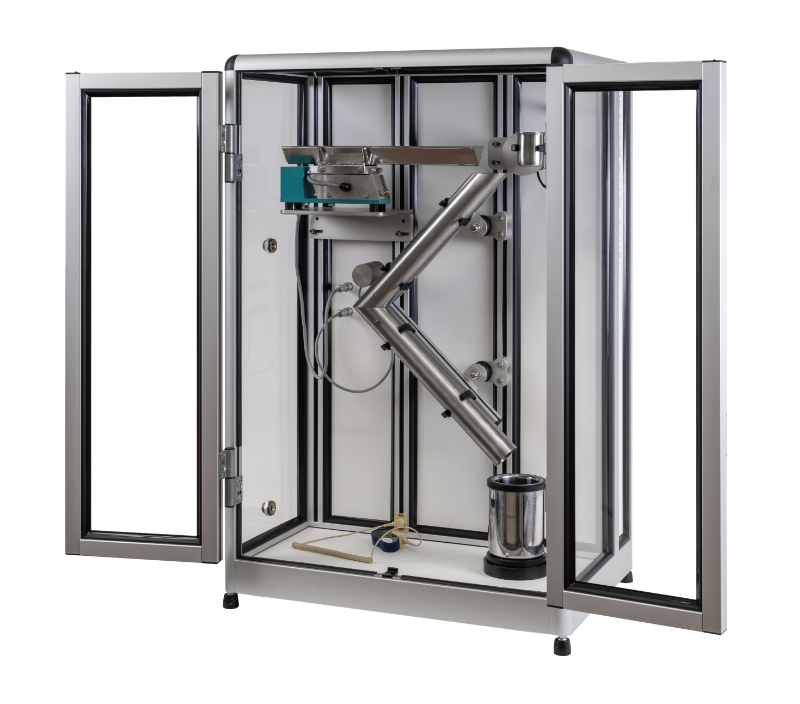
The GranuCharge provides a controlled and reproducible method for evaluating the triboelectric chargeability of powders in the laboratory. The powder flows through a vibrating V-tube before entering a Faraday cup connected to an electrometer. This geometry combines particle–particle friction, particle–wall friction and impacts against the tube, creating a well-defined contact history. Different tube materials and environmental conditions can be investigated, allowing formulations, raw-material suppliers, antistatic additives, humidity conditions and equipment materials to be compared before implementation on a production line.
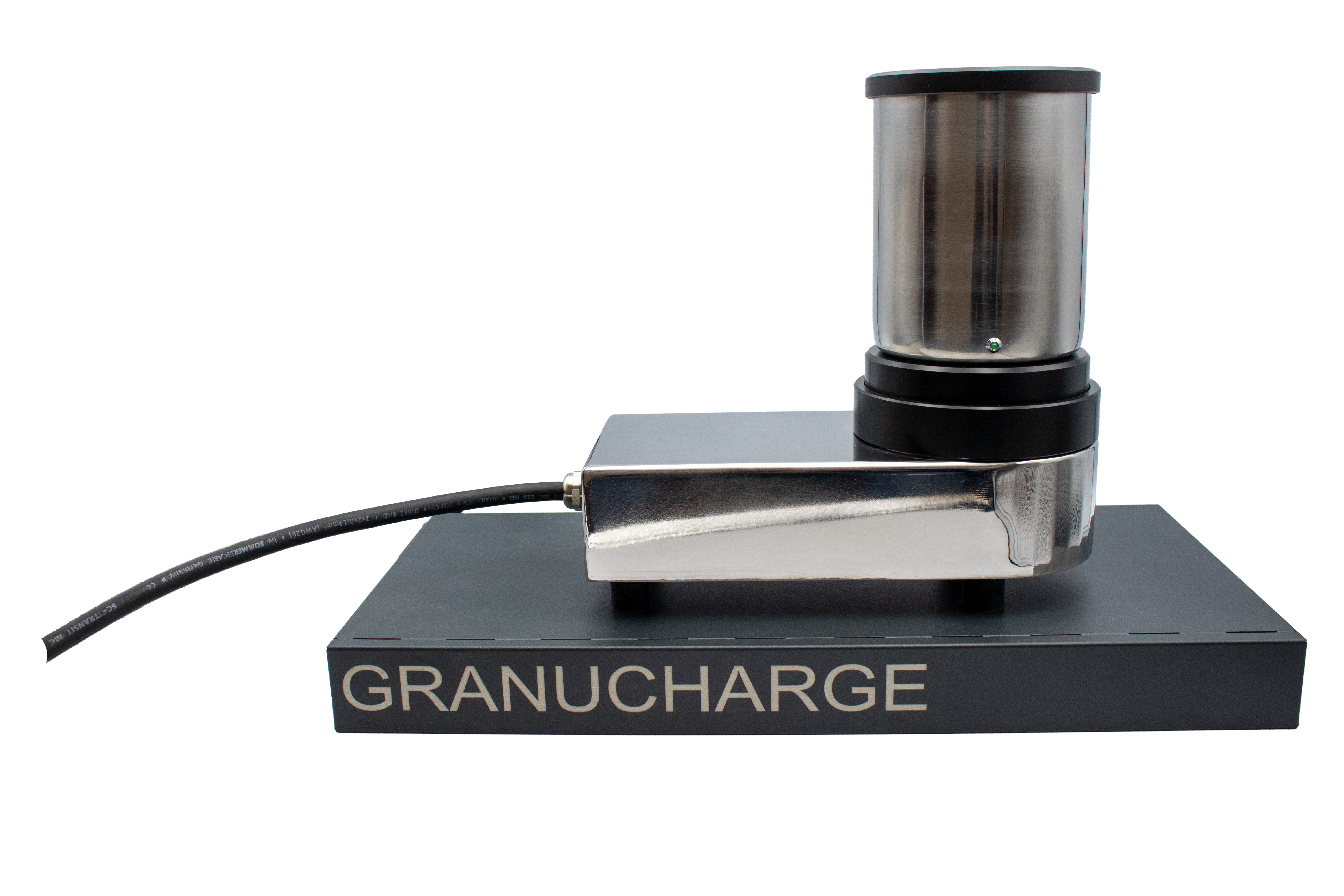
The GranuCharge At Line provides the complementary process perspective. Positioned at a selected point of the manufacturing line, it collects powder in a Faraday cup after the powder has passed through the actual equipment. An integrated load cell measures the collected mass, enabling immediate calculation of the charge per unit mass. The instrument therefore captures the effects of the real powder history, including transport, mixing, feeding and contact with specific equipment surfaces.
Together, the two instruments establish a coherent workflow: predicting electrostatic behavior under controlled laboratory conditions, measuring the charge generated by a real process, and using the comparison to guide process optimization.