
Solution guides
How to condition powder under cold conditions?
Powder flowability is influenced by a wide range of environmental factors, including temperature. While most powder characterization studies are performed at room temperature, some industrial applications require powders to be handled under cold conditions.
Understanding how low temperatures affect powder behavior can therefore be crucial for ensuring process stability and product quality.
A notable example is Polytetrafluoroethylene (PTFE) powder. PTFE should ideally be processed below 19°C because temperatures above this threshold can alter particle properties and affect flow behavior. As a result, evaluating powder flowability at reduced temperatures can provide valuable insights for process optimization, material handling, and quality control.
This article presents a simple and practical method for conditioning powders below room temperature before characterization.
Why Evaluate Powder Flowability at Low Temperature?
Temperature can influence several powder properties, including:
- Interparticle cohesion
- Electrostatic behavior
- Particle surface interactions
- Flow consistency during handling and processing
For certain materials, even small temperature variations can significantly impact performance. Measuring powder properties under the same thermal conditions as the intended process can therefore lead to more representative and reliable results.
A Simple Approach to Cooling Powders
Conditioning powders at low temperature does not necessarily require sophisticated environmental chambers. A well-insulated container combined with ice packs is often sufficient to cool a powder sample before testing.
The exact temperature reached by the powder will depend on several factors:
- The initial temperature of the cooling elements
- The position of the powder relative to the ice packs
- The insulation quality and size of the container
- The quantity of powder being conditioned
For this reason, direct temperature monitoring is recommended during conditioning.
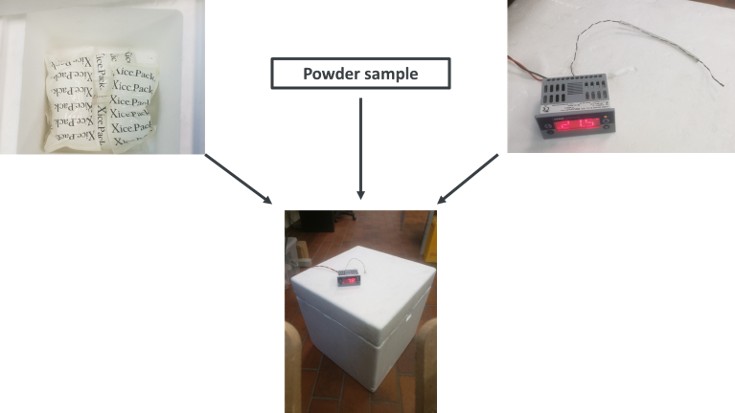
Figure 1: Pictures of the ice packs, the box, and the thermometric probe.
Characterizing the Powder After Cooling
Once the powder has been cooled to the desired temperature, it can be analyzed using standard powder characterization instruments such as, GranuDrum, GranuPack, GranuCharge, GranuHeap or GranuFlow.
Testing the conditioned powder immediately after removal from the insulated container helps preserve the target temperature during measurement and ensures more representative results.
For applications involving dynamic flow measurements, accessories such as the GranuDrum measurement cell can also be pre-cooled to minimize temperature changes during the experiment.
Understanding the Results
The effects of cooling are often revealed through changes in key flowability indicators. For example, Figure 2 shows the Dynamic Cohesive Index measured with the GranuDrum under room-temperature and cold-temperature conditions. The lower Dynamic Cohesive Index observed after cooling indicates reduced cohesion between particles, which corresponds to improved flowability.
In the specific case of PTFE, this behavior may be linked to the material's tendency to fibrillate above 19°C. Partial fibrillation of the long polymer chains can create entanglements between particles, increasing cohesion and reducing flow performance. Operating below this temperature therefore helps maintain more favorable flow characteristics.
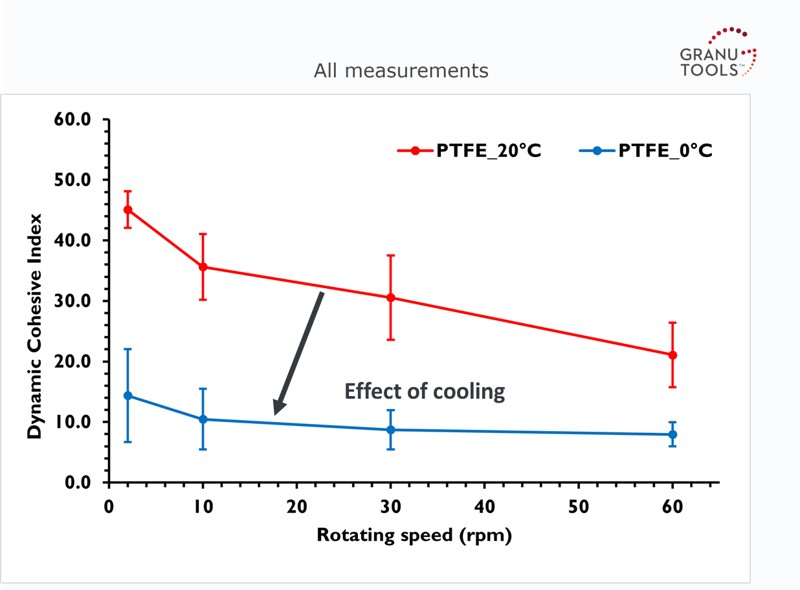
Figure 2: Dynamic Cohesive Index versus Rotating speed measured with the GranuDrum at room or cold conditions.
Practical Recommendations
When investigating the influence of temperature on powder behavior:
- Monitor powder temperature directly using a thermometric probe.
- Allow sufficient time for thermal equilibration.
- Keep transfer times between conditioning and testing as short as possible.
- Compare results with measurements performed on the same powder at room temperature.
- Repeat measurements to evaluate reproducibility.
These precautions help ensure that any observed differences are genuinely caused by temperature effects.
Conclusion
Cold conditioning is a simple yet effective way to investigate how temperature influences powder flowability. By cooling a powder sample before characterization and comparing the results with room-temperature measurements, users can better understand how materials behave in cold processing environments.
For temperature-sensitive powders such as PTFE, this approach can provide valuable information for optimizing storage conditions, handling procedures, and manufacturing operations while ensuring consistent powder performance.
FAQ – How to Condition Powder Under Cold Conditions
How can powder temperature be measured accurately during cooling?
A temperature probe placed directly inside the powder provides the most representative measurement of the powder temperature during conditioning.
What factors determine the final temperature reached by a powder sample?
The final temperature depends on the insulation efficiency, the amount of powder, the temperature of the cooling packs, and the positioning of the sample inside the cooling container.
Why is thermal equilibration important before powder characterization?
Thermal equilibration ensures that the entire powder sample reaches a stable and homogeneous temperature, improving measurement repeatability and comparability.
Can low temperature affect electrostatic powder behaviour?
Yes. Temperature variations can influence charge generation and retention, potentially modifying powder handling and process performance.
Why should cooled powders be tested immediately after conditioning?
Performing measurements immediately minimizes heat exchange with the surrounding environment and preserves the target temperature during characterization.