
Papers
Digital models of widely-used powder characterisation tools and their application in DEM calibration, Part II: Angle of repose testers
D. Werner et al., Digital models of powder characterisation tools for DEM calibration – Part II: Angle of repose testers, Powder Technology, 2026. https://doi.org/10.1016/j.powtec.2026.122586
Open‑source Digital DEM Models for Angle of Repose Testing
Accurate Discrete Element Method (DEM) simulations rely heavily on the quality of their calibration. While DEM is capable of reproducing granular dynamics with high quantitative accuracy, this potential can only be realised if the microscopic particle parameters used in simulations are properly aligned with experimentally measured macroscopic behaviour. Achieving this alignment remains one of the central challenges in DEM modelling of powders.
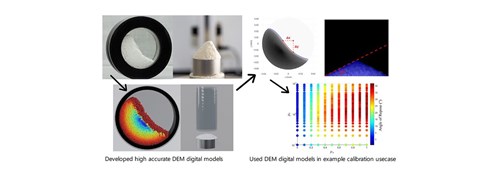
In a recent paper published in Powder Technology, Werner et al. present open‑source digital DEM models of widely used powder characterisation tools, focusing specifically on angle of repose testers. This work, entitled Digital models of widely‑used powder characterisation tools and their application in DEM calibration, Part II: Angle of repose testers, introduces validated digital models of the GranuHeap and GranuDrum instruments developed by Granutools.
Bridging Macroscopic Measurements and Microscopic DEM Parameters
Most experimental powder characterisation techniques, including angle of repose testing, provide access to bulk or macroscopic properties such as flowability or heap stability. In contrast, DEM simulations require particle‑scale parameters, including coefficients of sliding friction, rolling friction, restitution, and cohesion. Establishing direct, universal relationships between these two scales remains an open problem in granular mechanics.
A practical and increasingly adopted approach to DEM calibration consists in reproducing experimental characterisation tests numerically, using a digital replica of the physical instrument. By iteratively adjusting microscopic parameters until numerical and experimental results coincide, a consistent and physically grounded DEM calibration can be achieved.
The work presented by Werner et al. follows this methodology and provides the DEM community with validated digital twins of angle of repose testers, enabling rigorous and reproducible DEM calibration workflows.
Digital Models of GranuHeap and GranuDrum
The paper introduces DEM models of two complementary angle of repose instruments:
- GranuHeap, a static angle of repose tester, designed to provide highly repeatable measurements under controlled powder deposition conditions.
- GranuDrum, a dynamic rotating drum tester, capable of measuring dynamic angles of repose and providing deeper insight into powder cohesion and flow behaviour under motion.
The digital models reproduce not only the geometry of the instruments but also their operational procedures and data processing methods. CAD geometries, DEM simulation setups, and auxiliary analysis scripts are provided to ensure that numerical results can be analysed using the same metrics as experimental measurements.
This close correspondence between experiment and simulation allows direct, meaningful comparison between DEM outputs and real powder characterisation data.
Experimental Validation and Cross‑Calibration
To validate the digital models, the authors compare DEM simulations with experimental measurements obtained using two materials with distinct properties: spherical microcrystalline cellulose (MCC) particles and angular silica sand. These materials provide contrasting particle shapes and flow responses, allowing a robust assessment of the calibration procedure.
The study demonstrates that DEM parameters calibrated using the GranuHeap digital model can be successfully transferred and validated in simulations of the GranuDrum. Simulated dynamic angles of repose show very good agreement with experimental values, with deviations remaining within a few percent.
This cross‑validation confirms that the digital models capture the essential physics governing both static and dynamic angle of repose measurements and can therefore be reliably used for DEM calibration.
Open‑Source Access for the Scientific Community
A key contribution of this work is the open‑source release of the digital models. The complete DEM models, CAD files, and auxiliary codes are made freely available through public repositories, allowing researchers and industrial users to:
- Reproduce the results reported in the paper
Apply the digital models to new materials
Develop calibrated DEM simulations with improved transparency and repeatability
This initiative builds on previous work devoted to shear testers and powder rheometers and contributes to the development of a standardised ecosystem of digital powder characterisation tools.
Implications for DEM Modelling and Powder Technology
By providing validated digital models of GranuHeap and GranuDrum, this work offers a practical solution to one of the main challenges in DEM modelling: the reliable calibration of microscopic parameters from experimental data. The approach strengthens the link between powder characterisation experiments and numerical simulations, benefiting both academic research and industrial process modelling.
These open‑source digital twins further establish GranuHeap and GranuDrum not only as experimental characterisation tools, but also as reference instruments for DEM‑based powder simulation workflows.
Reference
D. Werner, A.L. Nicuşan, A. Neveu, G. Lumay, F. Francqui, J.P.K. Seville, B.D. Jenkins, C.R.K. Windows‑Yule, Digital models of widely‑used powder characterisation tools and their application in DEM calibration, Part II: Angle of repose testers, Powder Technology, 2026. https://doi.org/10.1016/j.powtec.2026.122586
Abstract
Discrete Element Method (DEM) simulations are capable of numerically reproducing the dynamics of a wide range of physical and industrial systems with quantitative accuracy; this accuracy, however, is dependent upon the precision with which they are calibrated. The calibration of DEM simulations is a non-trivial process, as standard powder characterisation tools typically provide only information regarding the bulk (macroscopic) properties of a given particulate material, whereas the calibration of DEM models requires detailed information regarding the particle-level (microscopic) parameters. The digital models presented in this paper enable researchers, both academic and industrial, to bridge the gap between the macro and micro scales, and thus produce more rigorous and reliable DEM simulations. In this work, we provide details and demonstrate potential applications of the digital models of two widely-used powder characterisation tools: a static angle of repose tester, and a dynamic angle of repose tester, specifically GranuHeap and GranuDrum (Granutools, Belgium) systems. Links are provided to open-source repositories in which the full DEM models, CAD geometries and auxiliary code associated with each digital model may be accessed by the reader and freely used in their own future research.
FAQ – Open‑source DEM Models for Angle of Repose Testing
What is the main objective of the digital DEM models presented in this work?
The digital DEM models are designed to support rigorous calibration of DEM simulations by reproducing real angle of repose experiments in a numerical environment.
Which powder characterisation instruments are modelled?
The paper presents digital DEM models of the GranuHeap static angle of repose tester and the GranuDrum dynamic rotating drum tester.
How are these models used for DEM calibration?
DEM calibration is performed by adjusting particle‑scale parameters until the simulated angle of repose matches experimental measurements obtained with the physical instrument.
Are the digital DEM models publicly available?
Yes. The DEM models, CAD geometries and auxiliary scripts are released as open‑source resources and are freely accessible for academic and industrial use.
Who can benefit from these open‑source DEM models?
These models are intended for researchers, DEM practitioners and engineers working on granular materials who require reliable and reproducible DEM calibration.