
Papers
From Flowability to Stress Transfer in Solid-State Hydrogen Storage Powders
C. Ngueloheu Yeda, T. Jeannin, A. Neveu, D. Chapelle, A. Maynadier, From flowability to stress transfer: Experimental characterization of TiFe(1−x)Mnx (x ≈ 0.1) intermetallic powders for solid-state hydrogen storage, Hydrogen, 7 (2), 44, 2026, https://doi.org/10.3390/hydrogen7020044
From Flowability to Stress Transfer: Experimental Characterization of 𝐓𝐢𝐅𝐞(𝟏−𝐱)𝐌𝐧𝐱(𝐱≈𝟎.𝟏)
Intermetallic Powders for Solid-State Hydrogen Storage
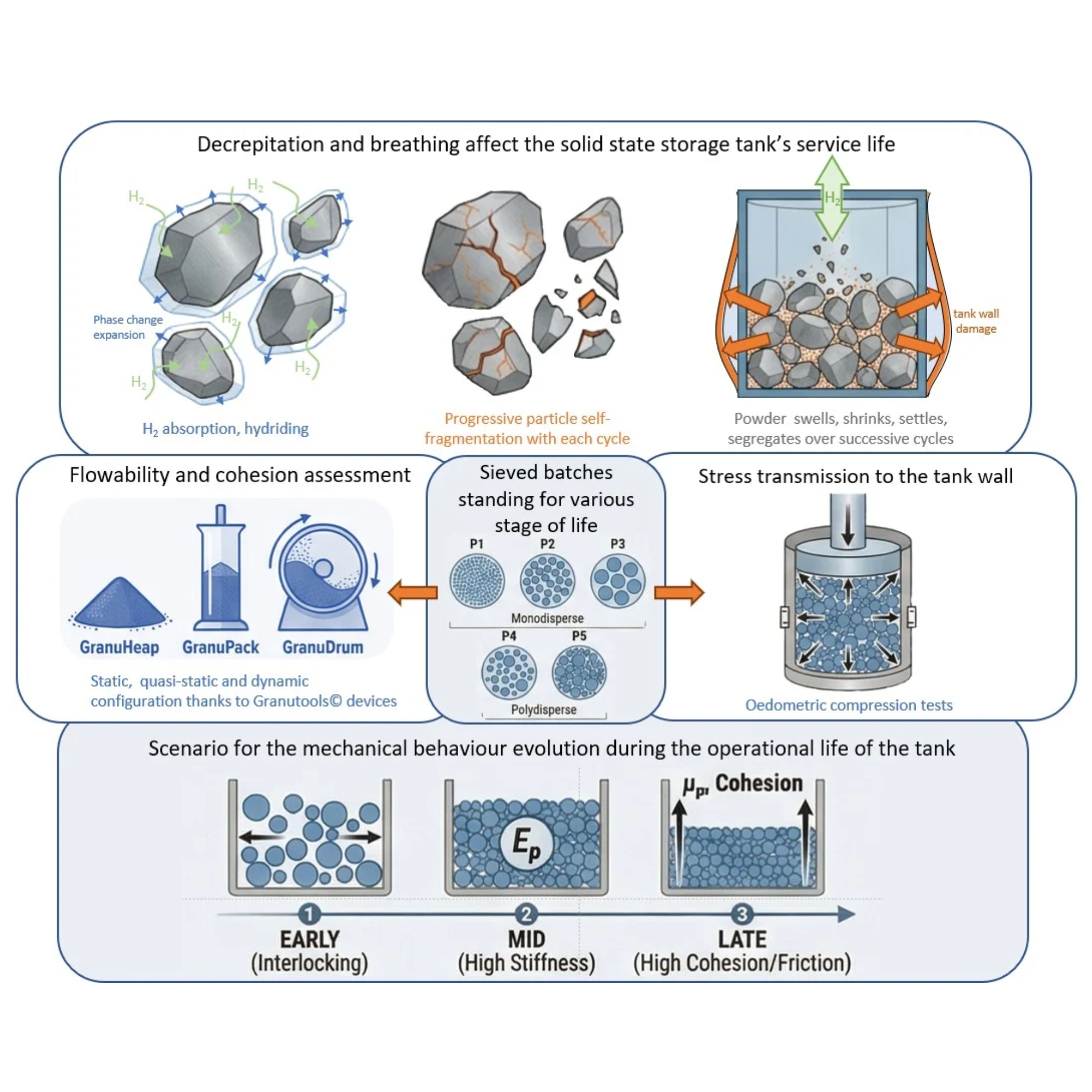
Solid-state hydrogen storage systems often rely on intermetallic alloy powders confined inside a tank. During repeated hydrogen absorption and desorption cycles, these powders undergo swelling, fragmentation, particle motion, and segregation. Over time, these mechanisms can significantly affect stress transmission within the powder bed and onto the tank walls, with important implications for storage system durability and safety.
In a recent study published in Hydrogen, researchers investigated the mechanical behavior of a widely used hydrogen storage material: TiFe(1−x)Mnx (x ≈ 0.1). The work focuses on understanding how particle size and polydispersity, representative of powder aging through decrepitation, influence flowability, cohesion, compressibility, and stress transfer in a confined environment.
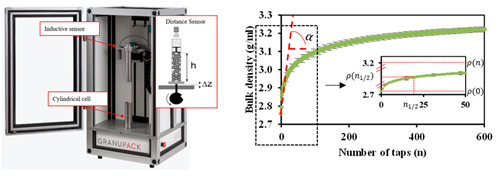
Five powder batches with controlled particle size distributions were studied to simulate different stages of fragmentation during cycling. Using Granutools flowability instruments (GranuDrum, GranuPack and GranuHeap) combined with an instrumented confined compression setup, the authors analyzed powder behavior under dynamic, quasi-static, static, and compressive loading conditions.
The results show that fine and polydisperse powders exhibit higher cohesion and shear-thickening behavior, while coarser powders display better flowability and quasi-Newtonian behavior. Under confined compression, particle size and especially polydispersity strongly affect the apparent stiffness of the powder bed and the way stresses are transmitted to the container walls. These findings highlight how particle fragmentation and segregation during hydrogen cycling can progressively modify mechanical interactions within the storage tank, contributing to wall deformation over time.
This study provides valuable experimental data and a methodological framework to support predictive modeling (e.g. DEM) and to guide the design and dimensioning of solid-state hydrogen storage tanks.