Blog
Granutools as a Reference Framework for DEM Model Calibration
How Granutools enables reliable DEM calibration through reference powder tests, digital twins, and integration with leading simulation platforms.
From experimental powder characterization to validated digital twins
Beyond experimental powder testing, Granutools provides a structured framework for the calibration and validation of Discrete Element Method (DEM) models, bridging the gap between laboratory measurements and predictive numerical simulations.
Thanks to their well defined, reproducible geometries and controlled stress states, instruments such as the GranuHeap, GranuDrum and GranuPack are particularly well suited as reference experiments for DEM calibration. These tests allow the extraction of macroscopic bulk responses that are directly comparable with DEM outputs, making them efficient tools for parameter identification and model validation.
DEM calibration based on standardized bulk responses
DEM calibration typically aims at identifying microscopic contact parameters (e.g. friction, rolling resistance, cohesion, restitution) that reproduce measured bulk behavior. Granutools instruments provide exactly this type of macroscopic response under well controlled and documented conditions:
- GranuHeap: Static angle of repose and heap morphology, sensitive to interparticle friction, particle shape effects, and cohesion.
- GranuDrum: Dynamic angle of repose and cohesive index as a function of rotational speed, enabling calibration under low stress, dynamic flow regimes, representative of many industrial processes.
Because the stress states, boundary conditions, and measurement definitions are clearly established, these tests are well suited for direct numerical replication and quantitative comparison with DEM simulations.
Integration into commercial DEM workflows: Altair® EDEM™ 2025.1
A significant step toward standardized DEM calibration was achieved with the integration of GranuHeap and GranuDrum digital twins into the EDEM Calibration Kit, included in Altair® EDEM™ 2025.1.
This integration enables users to:
- Automatically run DEM simulations of GranuHeap and GranuDrum reference tests
- Post process simulation results using the same definitions as the experimental instruments
- Directly compare simulated and measured macroscopic responses within a unified workflow
From a technical perspective, this approach transforms calibration from an ad hoc trial and error process into a repeatable, instrument based procedure, significantly reducing user dependent variability. It also allows calibration strategies based on multiple flow regimes, combining static and dynamic powder behavior.
By embedding Granutools reference tests into a commercial DEM environment, the calibration workflow becomes both traceable and transferable, which is essential for industrial and regulated applications.

Webinar "Industry-grade Powder Flow Calibration"
Advanced calibration strategies: RCPE and XPS
A complementary and more advanced calibration strategy is illustrated by the work of RCPE - Research Center Pharmaceutical Engineering, within their DEM software XPS (eXtended Particle Simulations).
Traditional DEM calibration relies on iterative simulations, where microscopic parameters are manually adjusted until the simulated bulk response matches experimental measurements (e.g. GranuDrum, shear cell). This process is computationally expensive and often non unique.
RCPE addresses this challenge by using data-driven calibration models, which explicitly learn the relationship between:
- Microscopic DEM parameters (contact and interaction properties)
- Macroscopic bulk responses measured with reference instruments such as the GranuDrum
Once trained, this model allows users to directly infer optimized DEM parameter sets, drastically reducing the number of required calibration simulations.
In app GranuDrum visualization
A recent technical enhancement further strengthens this approach: the integration of an in-app GranuDrum preview directly inside XPS. During calibration, users can now:
- Visually assess the dynamic behavior of the calibrated material
- Qualitatively validate flow regimes alongside quantitative metrics
- Ensure consistency between numerical predictions and experimental observations
This closes the loop between experimental reference tests, numerical calibration, and visual validation.
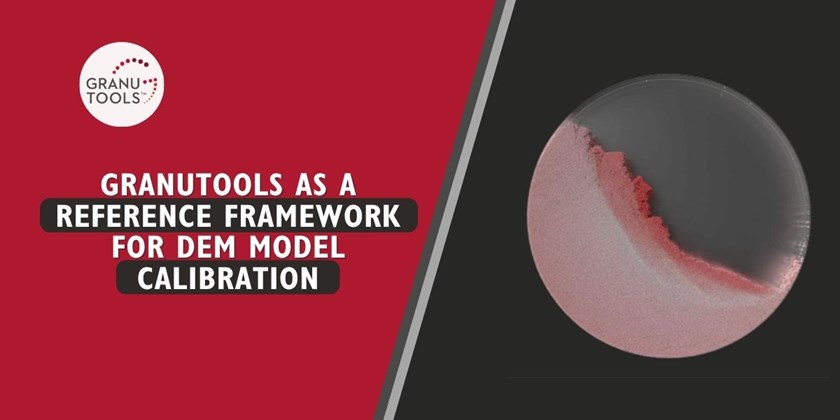
Demonstration of GranuDrum digital twin visualization in XPS (RCPE), presented by Thomas Forgber.
Toward robust and transferable DEM digital twins
Across different software platforms and calibration strategies, the same trend emerges: standardized experimental tests are essential to build reliable DEM digital twins.
By providing:
- Reference instruments with controlled stress states
- Well defined measurement metrics
- Digital twins compatible with commercial and open source DEM software
Granutools instruments have become reference benchmarks for DEM calibration, enabling consistent parameter identification, model comparison, and cross software validation.
This makes Granutools not only a supplier of powder testers, but a technical enabler for predictive, simulation driven powder engineering.
FAQ – From Experimental Characterization to DEM Digital Twins
What is a DEM digital twin for powders?
A DEM digital twin is a numerical model that reproduces the bulk behavior of a real powder based on calibrated particle-scale interaction parameters.
Why are standardized powder tests important for DEM calibration?
Standardized tests provide reproducible bulk responses under controlled stress states, enabling reliable comparison between experiments and DEM simulations.
Which Granutools instruments are commonly used for DEM calibration?
GranuHeap, GranuDrum, and GranuPack are commonly used as reference experiments to calibrate static, dynamic, and densification-related powder behaviors.
How does DEM software integrate these reference tests?
Digital twins of Granutools instruments can be embedded into DEM platforms to directly compare simulated and experimental macroscopic responses.
What is the benefit for industrial users?
This approach enables traceable, transferable, and repeatable DEM calibration workflows, reducing trial-and-error and improving predictive simulation accuracy.