
Solution guides
How to evaluate powder granulation with the GranuDrum
Discover how the GranuDrum can help assess the impact of granulation on powder flowability with this blog article.
Introduction
Granulation is a common phenomenon encountered in many powder processing operations. When powders flow, fine particles may agglomerate under the influence of cohesive forces, leading to the formation of larger granules. As a result, the particle size distribution evolves, which can significantly affect powder flowability and bulk behavior.
Granulation may be intentionally induced to improve handling properties, reduce dust generation, or facilitate downstream processing. In other situations, granulation can occur unintentionally during mixing, conveying, or thermal processing, potentially modifying product performance.
Because granulation directly influences flowability and processability, quantifying its effects is essential for optimizing formulations and monitoring process conditions. This article presents a simple method for evaluating granulation using the GranuDrum.
Why Measure Powder Granulation?
The formation of granules changes the way a powder flows. Compared with fine cohesive particles, granules generally:
- Exhibit lower interparticle cohesion.
- Flow more freely.
- Are less sensitive to electrostatic effects.
- Generate less dust.
- Show improved handling characteristics.
However, excessive granulation may also lead to segregation issues or changes in process performance.
Measuring the impact of granulation on powder flowability therefore provides valuable information for both formulation development and process control.
Comparing Fresh and Granulated Powders
The principle of this method is based on a direct comparison between:
- A fresh powder sample (non-granulated).
- The same material after a granulation step.
To ensure meaningful comparisons, all samples should be conditioned under identical environmental conditions before testing, particularly regarding moisture content.
Once the granulation process has been completed, both the fresh and granulated samples are characterized using the same GranuDrum measurement procedure.
Measuring Flowability with the GranuDrum
Each sample is analyzed using the standard GranuDrum speed-sequence mode.
The Dynamic Cohesive Index is measured over a range of rotational speeds and provides a quantitative evaluation of powder cohesion during flow.
Because granulation modifies particle size and particle interactions, changes in cohesion can be directly observed through the evolution of the Cohesive Index.
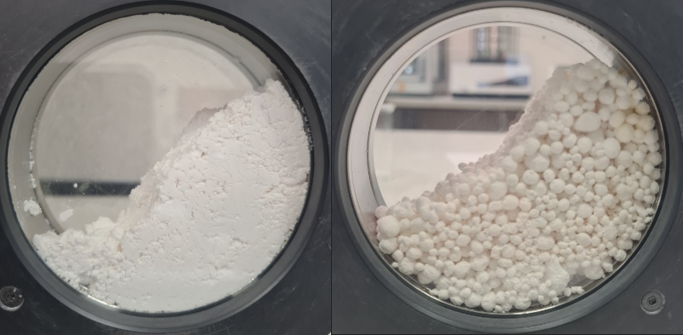
Figure 1: Left: non granulated sample. Right: sample after external granulation
LEARN MORE ABOUT THE GRANUDRUM
Understanding the Effect of Granulation
Figure 2 presents typical Cohesive Index curves obtained for fresh and granulated powders. The differences between both samples clearly reveal the influence of granulation on powder behavior.
As granules are formed:
- The proportion of fine particles decreases.
- Particle-particle cohesive interactions are reduced.
- Large agglomerates become less sensitive to attractive forces.
- Flowability improves.
These changes result in a significant reduction in the Cohesive Index measured by the GranuDrum.
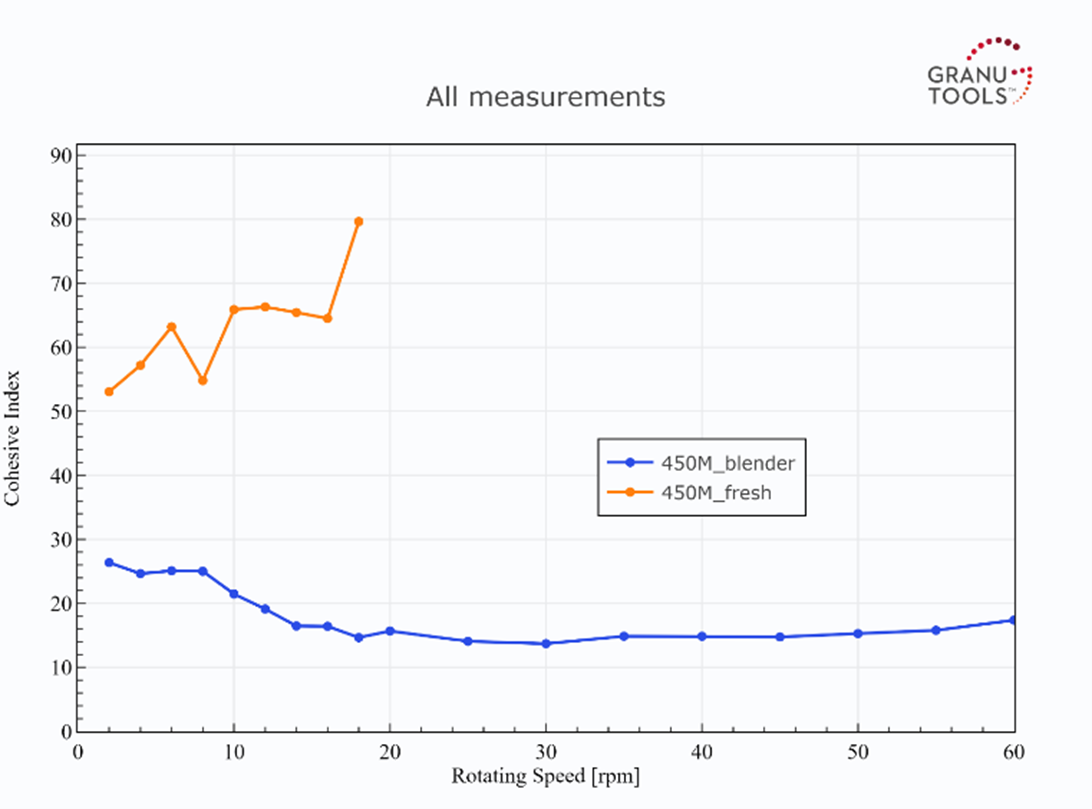
Figure 2: Cohesive Index versus Rotating Speed curves obtained for the fresh and granulated samples
Quantifying the Impact of Granulation
The main indicator used in this protocol is the Cohesive Index. In many cases, granulation leads to a substantial decrease in the Cohesive Index across the rotational-speed range. A lower Cohesive Index indicates:
- Lower cohesion.
- Improved powder mobility.
- Better flowability.
Conversely, powders that remain highly cohesive after processing will exhibit Cohesive Index values similar to those of the fresh material.
The reduction in Cohesive Index can therefore be used as a direct indicator of the effectiveness of the granulation process.
Example: Improved Flowability After Granulation
The example shown in Figure 2 illustrates a highly cohesive fresh powder that exhibits severe stickiness. Following granulation, the Cohesive Index decreases dramatically across the rotational-speed range.
This behavior demonstrates that the formation of larger agglomerates significantly reduces cohesion and improves powder flow. The comparison highlights the ability of the GranuDrum to detect and quantify the effects of granulation on bulk powder behavior.
Applications of the Method
The protocol can be applied to a wide range of granulation processes, including:
- High-shear granulation
- Wet granulation
- Dry granulation
- Thermal processing
- Rotary kiln processing
- Mixing-induced agglomeration
It can also be used to monitor granulation at different stages of a manufacturing process and assess changes in flowability throughout production.
Industrial Applications
Granulation characterization is particularly useful for:
- Pharmaceutical powders
- Food ingredients
- Fertilizers
- Battery materials
- Fine chemicals
- Powder metallurgy materials
The method provides a practical way to evaluate whether a granulation process delivers the desired flow properties.
Conclusion
The GranuDrum offers a simple and effective method for evaluating powder granulation through flowability measurements.
By comparing the Cohesive Index of fresh and granulated materials, users can quantify how granulation affects powder cohesion and bulk behavior. In many cases, the formation of larger granules leads to a significant reduction in cohesion and a corresponding improvement in flowability.
This protocol can be applied to virtually any granulation process and can also be used to monitor granulation levels throughout a production line.
FAQ – Evaluating Powder Granulation with the GranuDrum
What is powder granulation?
Granulation is the process by which fine particles agglomerate into larger granules, modifying particle size distribution and bulk powder behavior.
Why does granulation affect powder flowability?
Larger granules generally reduce cohesive interactions between particles, resulting in lower cohesion and improved flowability.
Which parameter is used to evaluate granulation with the GranuDrum?
The Cohesive Index is used to compare the flow behavior of fresh and granulated powders and quantify the impact of granulation.
Can this protocol be applied to different granulation technologies?
Yes. The method can be used with wet granulation, dry granulation, thermal granulation, blender-induced agglomeration, and other granulation processes.
What does a lower Cohesive Index indicate after granulation?
A lower Cohesive Index indicates reduced cohesion between particles and an improvement in powder flowability.