

Application notes
How to evaluate powder caking with GranuPack
Powder caking is important for industrial applications. Learn how the GranuPack can measure the caking and investigate it thanks to this protocol.

Introduction
Caking is a common issue in powder processing and storage. During storage, particles can form solid bridges due to moisture, pressure, temperature variations, or physicochemical interactions. As these bridges develop, powder mobility decreases and handling becomes more difficult.
In industrial environments, caking can lead to poor flowability, feeding issues, inconsistent processing, and reduced product quality. Understanding the tendency of a powder to cake under specific storage conditions is therefore essential for optimizing formulations, packaging, and storage strategies.
This article presents a simple method for evaluating caking using the GranuPack and a dedicated caking kit. By monitoring the evolution of powder packing dynamics after storage, users can quantitatively assess the progression of caking over time.
Why Measure Powder Caking?
Fresh powders generally consist of individual particles that can easily rearrange under mechanical vibration or tapping. As caking develops, solid bridges progressively restrict particle mobility.
This reduction in mobility affects several operations, including:
-
Powder discharge
-
Feeding and dosing
-
Conveying
-
Blending
-
Packing and densification
A reliable caking measurement should therefore quantify how storage affects the ability of particles to reorganize under mechanical solicitation. The GranuPack provides a direct way to monitor this behavior through the analysis of powder packing dynamics.
Want to learn why powder caking is an important phenomenon for industrial applications? Read our blog article.
Simulating Storage-Induced Caking
The GranuPack caking kit allows powders to be stored under controlled conditions while applying a constant load. A powder sample is placed directly inside the GranuPack measurement cell and subjected to a defined consolidation pressure for a specified Storage Time. During storage, interparticle bridges may progressively develop, reducing the ability of particles to move and rearrange. Repeating the protocol for increasing Storage Times makes it possible to monitor the evolution of caking quantitatively.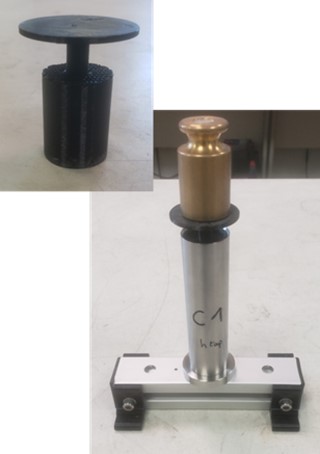
Figure 1: Picture of the outside cells
LEARN MORE ABOUT THE GRANUPACK
Measuring Packing Dynamics After Storage
After storage, the powder is characterized directly using the GranuPack.
The test is performed with a fixed tapping frequency and a defined number of taps, allowing the evolution of powder densification to be monitored accurately.
Because caked particles exhibit reduced mobility, their densification behavior differs significantly from that of fresh powders.
The packing dynamics therefore provide a direct indication of the degree of caking developed during storage.
Understanding the Packing Dynamic Parameter α
The key metric used in this protocol is the packing dynamic parameter α, introduced by Lumay et al. (2020).
The parameter α quantifies how easily particles reorganize during densification.
When particles remain free to move:
- Rearrangement is efficient.
- Densification occurs rapidly.
- α exhibits larger values.
When caking develops:
- Solid bridges restrict particle motion.
- Rearrangement becomes more difficult.
- Densification slows down.
- α decreases.
Consequently, α can be used as a direct indicator of particle mobility and therefore of caking intensity.
Monitoring Caking Evolution Over Time
Figure 2 illustrates the effect of increasing Storage Time on the packing behavior of a fine sugar powder. Even after a relatively short storage period, measurable differences can be detected thanks to the high sensitivity of the GranuPack. As storage time increases, bridge formation becomes more extensive and the powder progressively loses its ability to rearrange. This behavior is reflected by a continuous decrease in α.
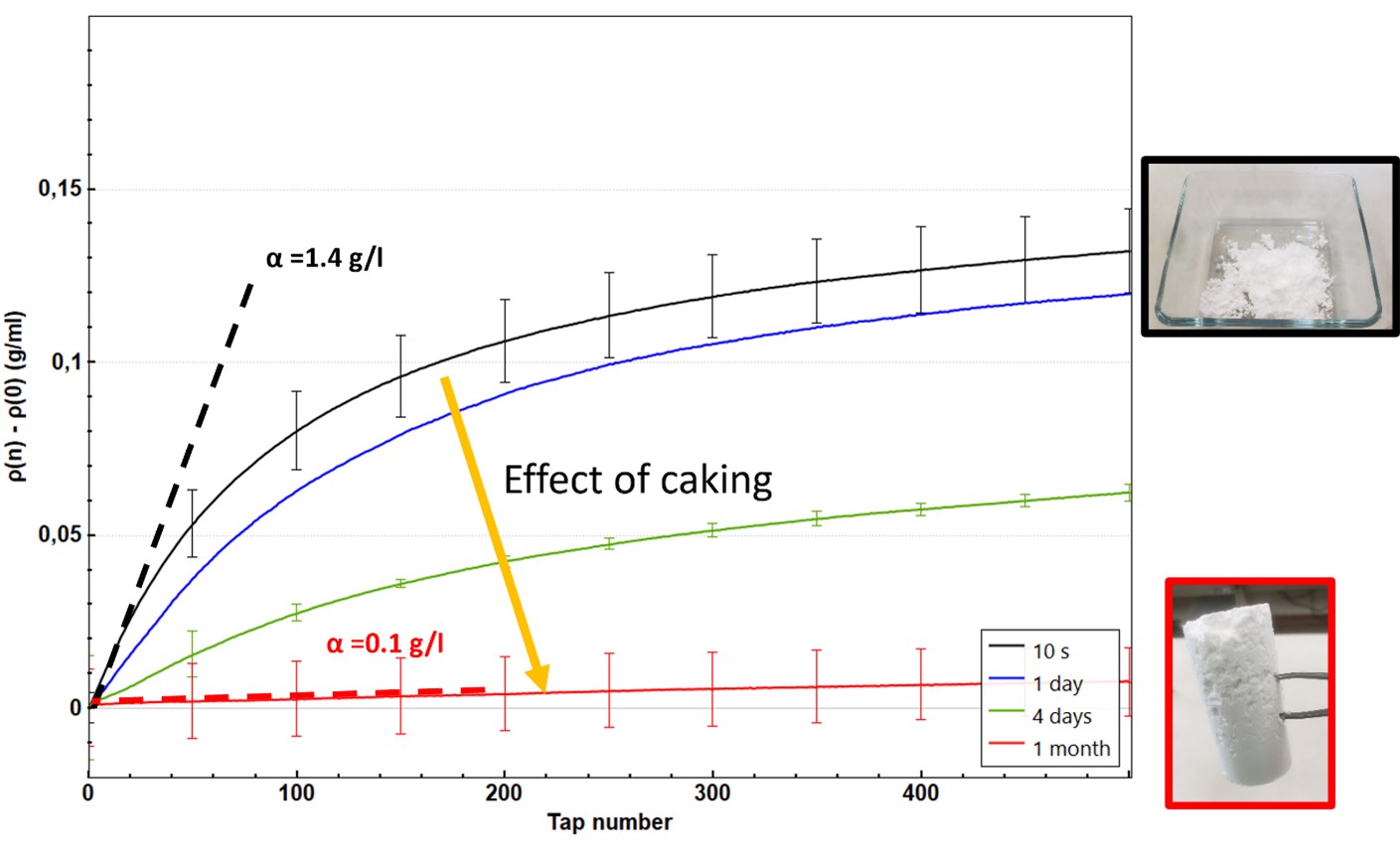
Figure 2: Effect of the caking on the powder packing
Interpreting the α Parameter
The evolution of α provides direct insight into caking development:
- High α values indicate good particle mobility and limited caking.
- Intermediate α values indicate partial bridge formation and increasing caking.
- Low α values indicate strong bridge formation and severe caking.
A fully caked powder behaves increasingly like a solid body and can no longer densify efficiently during tapping. In this situation, α tends toward zero.
Example: Fine Sugar
Figure 3 presents the evolution of α for a fine sugar powder stored under load.
The results demonstrate a progressive decrease of α with Storage Time. Between the shortest conditioning period and one month of storage, α decreases by approximately one order of magnitude. This substantial reduction reveals the progressive formation of a strongly interconnected structure within the powder bed. After one month, the powder behaves almost as a solid block, confirming severe caking.
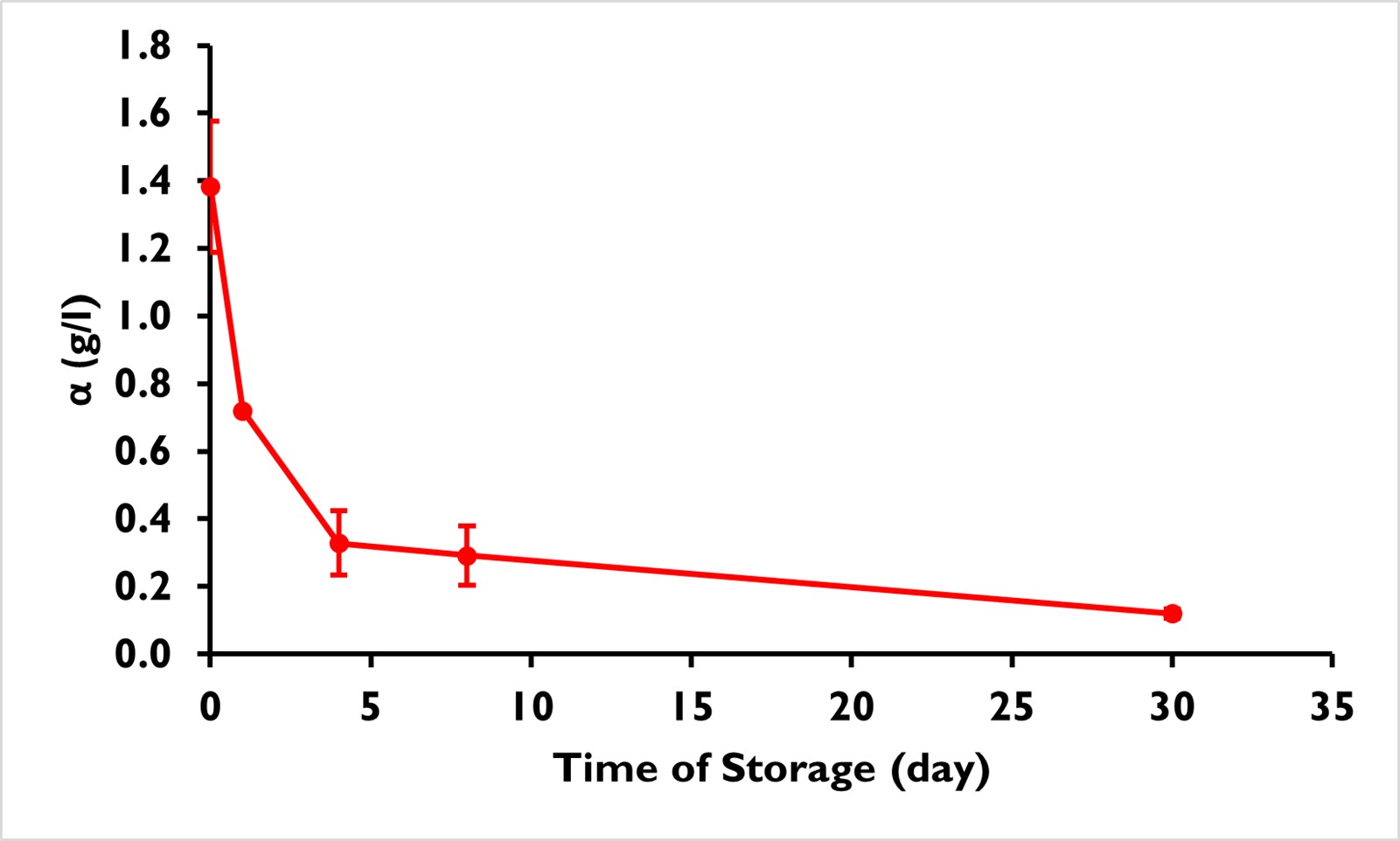
Figure 3: Decrease in α with Time of Storage assessing the caking evolution
Investigating Storage Conditions
One of the main advantages of the GranuPack caking protocol is its flexibility.
The removable cell can be stored under different conditions, including:
- Various humidity levels
- Different temperatures
- Different consolidation pressures
- Controlled environmental conditions
- Various storage durations
This makes it possible to identify which parameters promote or limit caking and helps optimize storage conditions.
Industrial Applications
The method is relevant for many industries, including:- Pharmaceuticals
- Food ingredients
- Dairy powders
- Specialty chemicals
- Battery materials
- Additive manufacturing powders
- Powder metallurgy
Conclusion
The GranuPack provides a simple and highly sensitive method for evaluating powder caking through the analysis of packing dynamics.
By monitoring the evolution of the parameter α, users can quantify the loss of particle mobility caused by bridge formation during storage. As caking progresses, α decreases, providing a direct measure of caking intensity.
Combined with controlled storage conditions and the dedicated caking kit, this protocol offers an effective way to investigate the influence of time, humidity, temperature, and consolidation pressure on powder caking behavior.
FAQ – Evaluating Powder Caking with GranuPack
What does the parameter α represent in GranuPack measurements?
The parameter α quantifies particle mobility during densification. Higher values indicate greater particle rearrangement capability, while lower values indicate restricted mobility caused by caking.
Why does α decrease when caking develops?
Caking creates solid bridges between particles that restrict movement and limit the ability of the powder to densify during tapping, leading to lower α values.
Can caking be detected after relatively short storage times?
Yes. The sensitivity of the GranuPack makes it possible to detect changes in powder packing behavior even after short storage periods.
What does an α value close to zero indicate?
An α value approaching zero indicates that the powder behaves almost like a solid block and can no longer reorganize efficiently during densification.
Which conditioning parameters can be investigated with this protocol?
Storage time, humidity, temperature, consolidation pressure, and environmental conditions can all be varied to study their influence on caking behavior.